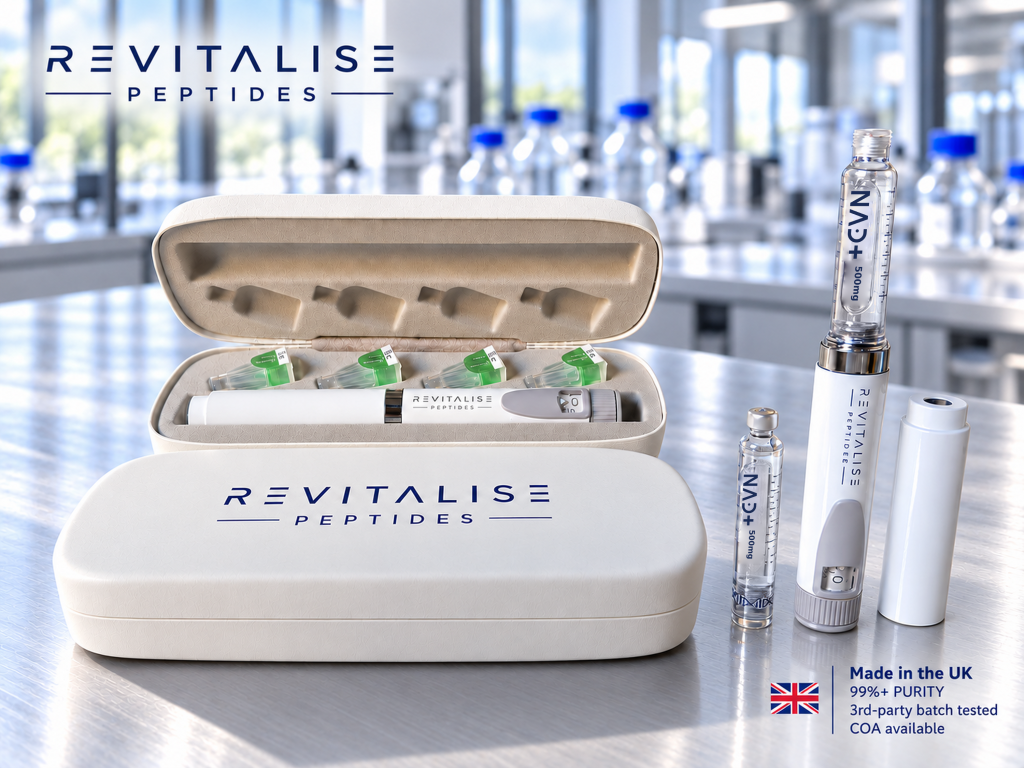
Laboratory Peptide Handling Guide for Research
A peptide can arrive with suitable analytical documentation and still become unsuitable for a defined experiment through poor handling at the bench. This laboratory peptide handling guide sets out a practical workflow for receiving, identifying, storing and preparing research materials while preserving traceability. It applies to unconstituted vials, cartridges and other laboratory-use formats, but it does not replace the product-specific instructions or stability information supplied for a particular material.
All peptide materials discussed here are for laboratory research use only. Their handling should be planned within the restrictions of the research setting, the material documentation and the applicable institutional procedures. A research-use label does not remove the need for appropriate risk assessment, training or records.
Start with the product documentation
Before opening a vial or cartridge, match the physical item to its documentation. Record the product name, batch or lot identifier, stated content, date received and the condition of the packaging. If the supplier provides a certificate of analysis, retain it alongside the study record rather than treating it as a one-time purchasing check.
A certificate of analysis can answer useful but limited questions. It may identify the batch, analytical methods used and reported result for that batch. It does not, by itself, establish that a material remains unchanged after delivery, repeated handling or preparation in a different laboratory environment.
Three terms are often wrongly treated as interchangeable:
| Question | What it concerns | What it does not establish alone | |—|—|—| | Purity | The proportion of the tested sample attributed to the intended component under the stated method | The exact mass of peptide in the container | | Content | The quantity of material reported in a vial, cartridge or batch | Chemical identity or chromatographic purity | | Identity | Whether the detected molecular mass is consistent with the expected compound | Freedom from all impurities or degradation products |
High-performance liquid chromatography, commonly shortened to HPLC, separates components in a sample and is often used to assess chromatographic purity. Mass spectrometry measures mass-to-charge signals and can support identity confirmation. Neither method answers every quality question in isolation. Method conditions, reference materials, sample preparation and the laboratory’s acceptance criteria all affect what a result means.
For a considered reading of batch paperwork, keep the analytical method, the reported result and the scope of the claim separate. A documented assay result is more useful when it is clearly tied to the lot in hand.
Receipt and quarantine: prevent mix-ups early
The most preventable errors occur before an experiment begins. On receipt, inspect the outer packaging for damage, check that labels are legible and compare the order details against the item received. If there is a discrepancy, photograph the issue, isolate the item and contact the supplier before placing it into the normal research inventory.
A short quarantine step is valuable for small research operations as well as larger laboratories. Mark materials as received but not yet released for study until the item, accompanying documentation and internal inventory entry agree. This avoids a familiar problem: a vial is placed in storage promptly, but its lot details and intended project are reconstructed from memory weeks later.
Assign an internal sample identifier where needed. The identifier should connect the original container, the batch record, any prepared aliquots and the relevant experimental notebook. Do not obscure the supplier label. An additional label is preferable to a replacement label.
Storage must follow material-specific evidence
There is no universal storage condition or shelf life that can be applied safely to all peptides, formats or prepared solutions. Sequence, counter-ion, excipient profile, container closure, water exposure and handling history can all affect stability. Follow the storage conditions supplied for the exact product and batch where these are available, along with your laboratory’s validated storage procedures.
The practical objective is consistency. Avoid unnecessary movements between storage environments, uncontrolled exposure during stock checks and repeated opening of a container that does not need to be accessed. Keep an inventory record showing the location, date placed into storage and any notable event such as a delivery delay, damaged seal or unexpected temperature excursion.
For refillable research formats, also distinguish between the documentation for the peptide material and the instructions for the device or container system. The handling limits of a cartridge, reusable pen body or accessory should not be assumed to be identical to those of an unconstituted vial.
Prepare solutions with a written plan
Reconstitution is not simply the point at which a dry material becomes usable. It is a preparation step that changes the sample history and should be recorded as such. Before starting, define the required concentration, the solvent or diluent specified by the experimental method, the final volume and the number of portions needed for the work.
Use appropriately clean, compatible laboratory equipment and follow local aseptic procedures where the experiment requires them. The choice of diluent and container can matter. Peptides may interact with surfaces, and prepared solutions can be affected by pH, ionic strength, light exposure and repeated freeze-thaw handling. The relevant conditions depend on the specific analyte and study design, so a general handling article cannot prescribe one solvent or preparation method for every peptide.
Record the preparer’s initials, date and time, starting material identifier, diluent identifier, calculated concentration, actual final volume and storage location. Where a solution is divided into working portions, label each portion with a unique identifier linked back to the parent vial. This provides a clear route for investigating an unexpected result without assuming the original material was at fault.
Reduce contamination and degradation risks
A controlled bench routine is more valuable than adding complexity after a problem occurs. Work with one material at a time where possible, use clearly labelled equipment and return materials to their documented storage conditions promptly. Keep the workspace organised so that caps, containers and records do not become separated.
Common avoidable failures include using an unlabelled prepared solution, reusing equipment without a defined cleaning process, recording concentrations after rather than during preparation, and opening a stock repeatedly for small withdrawals. These issues can compromise traceability even when no visible change is apparent.
For studies sensitive to concentration or chemical integrity, consider defining acceptance criteria before work starts. This might include a maximum number of handling events, a fixed observation window, a requirement for a retained reference portion or repeat analytical confirmation where the study warrants it. The right control level depends on the cost of error, the duration of the project and whether the result will inform further research decisions.
Build a record that can answer questions later
A useful handling record should allow another competent researcher to understand what happened without relying on recollection. At minimum, retain the original documentation, receipt date, batch identifier, storage record, preparation calculation, prepared-sample labels and any deviation notes.
Where results are unexpected, investigate in sequence. Confirm sample identity first, then review preparation calculations, storage history, equipment status and assay conditions. It is tempting to attribute variation immediately to the material itself, but experimental outcomes may reflect several variables. A disciplined record makes those variables visible.
The same approach supports procurement. When comparing research materials, request or review documentation that is specific enough to identify the product and, where applicable, its lot. Assess whether the stated analytical methods answer the question relevant to your project, rather than relying on a broad purity claim alone.
A practical close-out for each research session
At the end of a handling session, reconcile what was used, what was prepared and what remains. Update container status, return materials to the specified storage environment and file any new records with the parent batch documentation. If an issue occurred, document it while the details are clear, even if the material is not immediately rejected.
Careful peptide handling is less about a single perfect procedure than a repeatable chain of decisions. Review the documentation for the exact research material before use, then make the laboratory record detailed enough to support the next experiment and any later investigation.