GH Secretagogue Research Guide for Laboratory Buyers
A GH secretagogue research guide starts with a distinction that is often blurred in product descriptions: a growth-hormone secretagogue is defined by the signalling pathway it activates, not by a presumed research outcome. These compounds are used to investigate regulated growth hormone release, receptor pharmacology, hypothalamic-pituitary signalling and downstream endocrine markers. They are laboratory research materials, not medicines, and the available evidence does not establish therapeutic use.
What is a GH secretagogue?
GH secretagogues are compounds studied for their capacity to stimulate release of growth hormone (GH) through specific endocrine signalling routes. The best-characterised route involves the growth hormone secretagogue receptor, now generally called GHS-R1a. This G-protein-coupled receptor is expressed in relevant hypothalamic and pituitary tissues and was identified before its endogenous ligand was known.
Howard and colleagues described the receptor in 1996, demonstrating that it functioned in pituitary and hypothalamic systems associated with GH release. Three years later, Kojima and colleagues identified ghrelin as an endogenous ligand for the receptor. Those findings gave the field a clearer framework: synthetic secretagogues and ghrelin-related compounds can be used to examine receptor-mediated signalling, while growth hormone-releasing hormone (GHRH) analogues address a related but distinct receptor system.
That difference matters when defining a study. A compound acting at GHS-R1a is not interchangeable with a GHRH analogue simply because both may be associated with GH release in an experimental setting. They differ in receptor target, signalling behaviour, temporal response and the most relevant controls.
GH secretagogue research guide: separate the pathways first
A useful study plan begins by identifying the pathway under investigation rather than selecting a compound by category name alone. In broad terms, GH secretagogue research commonly falls into three overlapping areas: ghrelin receptor pharmacology, pituitary secretory signalling and integrated endocrine response.
| Research question | Relevant pathway | Useful experimental consideration | |—|—|—| | Does a test material engage GHS-R1a? | Ghrelin receptor signalling | Use receptor-expression and receptor-negative controls where feasible. | | Does signalling alter GH release in a model? | Pituitary somatotroph activity | Account for basal secretion, sampling time and biological variability. | | Is a downstream marker altered after exposure? | Endocrine and hepatic signalling | Treat indirect markers separately from direct receptor or GH measurements. | | How does a GHS-R ligand compare with a GHRH analogue? | Distinct receptor systems | Match comparator concentration ranges and assay conditions to each material. |
GH release is pulsatile. A single measurement may reflect the timing of endogenous secretion as much as the experimental condition, especially in whole-animal or translational models. For that reason, repeated sampling designs, time-course analysis and properly matched vehicle controls are often more informative than an isolated endpoint.
Researchers should also avoid treating IGF-1 as a direct proxy for receptor activity. It is a downstream marker influenced by tissue context, nutritional status, hepatic signalling and study duration. It may be appropriate for an integrated endocrine question, but it cannot by itself demonstrate direct GHS-R1a engagement.
What the evidence does, and does not, show
The foundational evidence for this class is mechanistic. Howard et al. reported cloning and characterisation of a receptor in pituitary and hypothalamus that functions in growth hormone release in Science (1996; 273: 974-977). Kojima et al. identified ghrelin from rat stomach as an endogenous growth-hormone-releasing peptide in Nature (1999; 402: 656-660; DOI: 10.1038/45230). These are identifiable primary studies that support the biological basis for GHS-R research.
Cellular work can help establish receptor activation, second-messenger responses or secretion from a defined model. Such findings are useful for mechanism, but they cannot answer questions about whole-organism endocrine regulation. Animal studies add physiological context, while also introducing species differences in receptor expression, metabolism, feedback loops and sampling conditions.
Human research, where available in the published literature, should be read as a separate evidence tier rather than as confirmation of results from cells or animals. Differences in participant characteristics, study design, formulation and endpoint timing can materially affect findings. No laboratory procurement decision should convert mechanistic or preclinical evidence into a claim of clinical effect.
Designing a defensible research workflow
The most reliable GH secretagogue studies make the analytical plan explicit before material is selected. For receptor-focused work, that may mean defining a functional readout such as calcium mobilisation, intracellular signalling or reporter activity. For secretion studies, the plan should state how GH is measured, how samples are timed and how basal variation will be handled.
Assay interference deserves attention. Peptide test materials, matrix components and immunoassay reagents can all influence a result. Include matrix-only controls where relevant, assess assay linearity across the expected measurement range and retain sufficient sample for repeat analysis. If the project compares several materials, run them under matched conditions rather than inferring comparability from separate experiments.
A practical workflow should also distinguish identity confirmation from biological testing. A material can produce an apparent signal for reasons unrelated to the intended sequence or target, including contamination, degradation, aggregation or an unsuitable solvent system. Orthogonal confirmation – for example, combining a receptor-specific assay with an independent analytical check – reduces the chance of overinterpreting a single positive result.
Documentation: purity, content and identity are different questions
For GH secretagogue research, procurement documentation should be reviewed against the experimental need. A certificate of analysis can be valuable, but only when its methods, batch reference and stated results are understood. It is not a universal guarantee of fitness for every assay.
HPLC is commonly used to assess chromatographic purity by separating components in a sample. A high HPLC purity figure may indicate that one principal peak dominates under the stated method, but it does not independently prove the molecular identity of that peak. Mass spectrometry addresses a different question: whether an observed molecular mass is consistent with the expected compound. Neither result, on its own, fully answers the question of peptide content or biological activity.
Content concerns the amount of the intended material present in a vial or preparation. It may be affected by peptide form, counterions, water content and the method used for quantification. Researchers planning concentration-sensitive work should therefore avoid assuming that a nominal vial label alone resolves all content-related uncertainty.
Before purchasing, record the batch or lot identifier, the stated analytical methods, the tested material description and any limitations in the certificate. If independent testing or product verification is claimed for a particular item, check the current documentation for that specific batch rather than applying a general statement across a catalogue. Revitalise Peptides presents its materials for laboratory research only; researchers should assess the documentation provided for the exact format being considered.
Selecting a format for the research plan
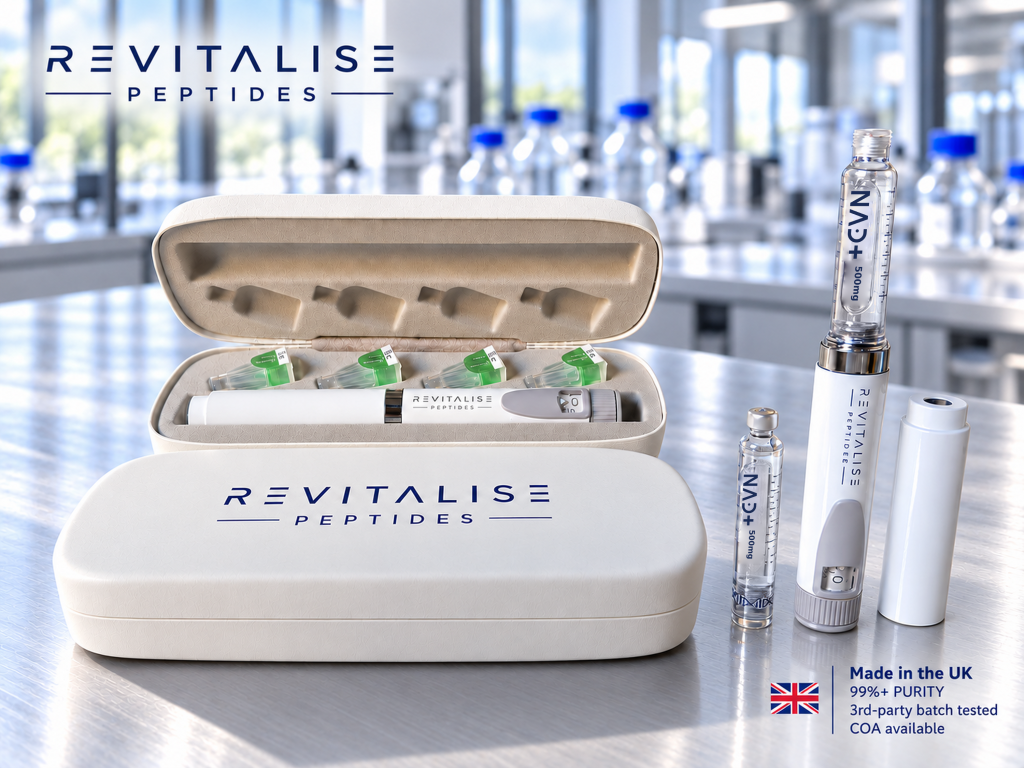
The appropriate format depends on the project’s handling requirements, not simply the amount of material required. Unconstituted vials may suit researchers who need direct control over preparation within their own documented workflow. Refill cartridges or reusable pen formats may be relevant to structured laboratory handling workflows, but compatibility, transfer risk, labelling and traceability should be evaluated before use.
Where a project uses multiple materials or repeat time points, a bundle or organised format may simplify stock control. That convenience should not replace good laboratory practice. Maintain records of batch identity, preparation date, storage conditions supported by the manufacturer’s documentation, and any observed change in appearance or assay performance.
Do not assume a universal storage temperature, usable period or stability profile for peptides. Stability depends on the individual sequence, format, solvent and available manufacturer or batch-specific information. If the documentation does not support a proposed storage or handling condition, treat that as an unresolved variable in the method rather than filling the gap with a generic rule.
Questions worth resolving before procurement
A focused purchasing decision is easier when the study team can answer four questions. First, which receptor or biological process is actually being investigated? Second, what analytical evidence is required for the intended assay? Third, does the available batch documentation distinguish identity, chromatographic purity and content clearly enough? Fourth, can the selected format be tracked through preparation, storage and analysis without adding avoidable uncertainty?
For UK-based procurement, delivery timing and destination eligibility should be checked against the supplier’s current shipping policy rather than assumed from product availability. Documentation review should happen before the material is scheduled into an experiment, particularly where a study has limited samples or tightly timed analytical work.
The most useful next step is to set the receptor question, assay readout and documentation threshold on the same page of the study plan. That small discipline makes it easier to choose a GH secretagogue research material that fits the work – and to interpret the resulting data with appropriate restraint.