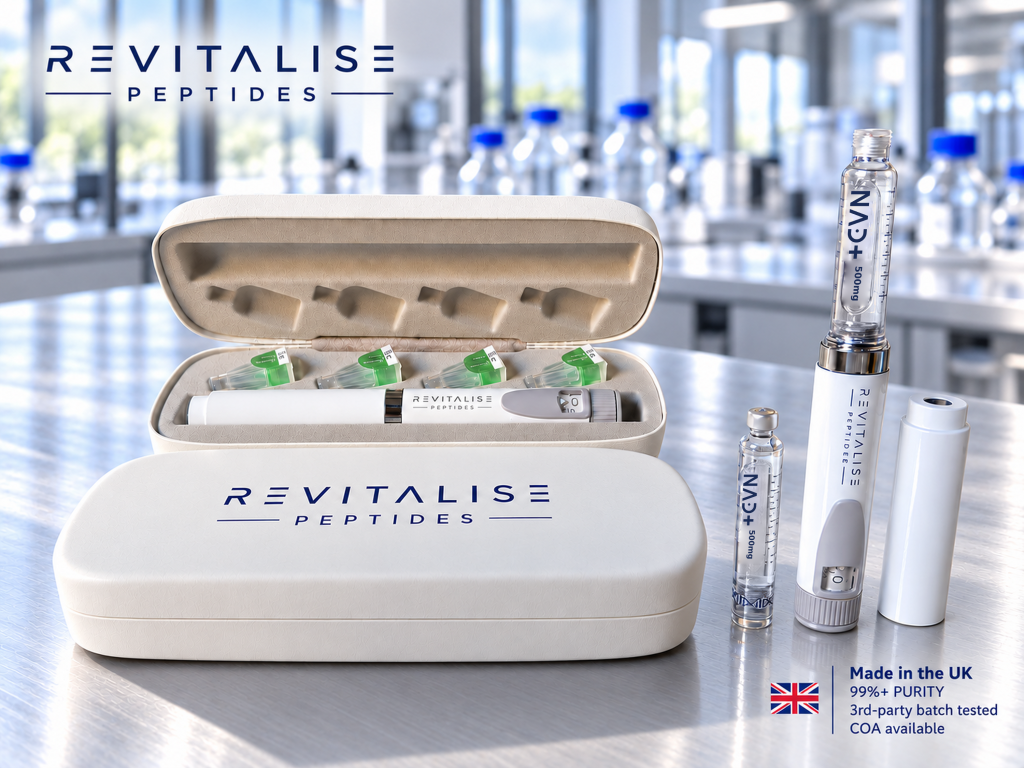
Laboratory Peptide Handling Guide for Research
A peptide can arrive with suitable analytical documentation and still become unsuitable for a defined experiment through poor handling at the bench. This laboratory peptide handling guide sets out a practical workflow for receiving, identifying, storing and preparing research materials while preserving traceability. It applies to unconstituted vials, cartridges and other laboratory-use formats, but it does not replace the product-specific instructions or stability information supplied for a particular material.
All peptide materials discussed here are for laboratory research use only. Their handling should be planned within the restrictions of the research setting, the material documentation and the applicable institutional procedures. A research-use label does not remove the need for appropriate risk assessment, training or records.
Start with the product documentation
Before opening a vial or cartridge, match the physical item to its documentation. Record the product name, batch or lot identifier, stated content, date received and the condition of the packaging. If the supplier provides a certificate of analysis, retain it alongside the study record rather than treating it as a one-time purchasing check.
A certificate of analysis can answer useful but limited questions. It may identify the batch, analytical methods used and reported result for that batch. It does not, by itself, establish that a material remains unchanged after delivery, repeated handling or preparation in a different laboratory environment.
Three terms are often wrongly treated as interchangeable:
| Question | What it concerns | What it does not establish alone | |—|—|—| | Purity | The proportion of the tested sample attributed to the intended component under the stated method | The exact mass of peptide in the container | | Content | The quantity of material reported in a vial, cartridge or batch | Chemical identity or chromatographic purity | | Identity | Whether the detected molecular mass is consistent with the expected compound | Freedom from all impurities or degradation products |
High-performance liquid chromatography, commonly shortened to HPLC, separates components in a sample and is often used to assess chromatographic purity. Mass spectrometry measures mass-to-charge signals and can support identity confirmation. Neither method answers every quality question in isolation. Method conditions, reference materials, sample preparation and the laboratory’s acceptance criteria all affect what a result means.
For a considered reading of batch paperwork, keep the analytical method, the reported result and the scope of the claim separate. A documented assay result is more useful when it is clearly tied to the lot in hand.
Receipt and quarantine: prevent mix-ups early
The most preventable errors occur before an experiment begins. On receipt, inspect the outer packaging for damage, check that labels are legible and compare the order details against the item received. If there is a discrepancy, photograph the issue, isolate the item and contact the supplier before placing it into the normal research inventory.
A short quarantine step is valuable for small research operations as well as larger laboratories. Mark materials as received but not yet released for study until the item, accompanying documentation and internal inventory entry agree. This avoids a familiar problem: a vial is placed in storage promptly, but its lot details and intended project are reconstructed from memory weeks later.
Assign an internal sample identifier where needed. The identifier should connect the original container, the batch record, any prepared aliquots and the relevant experimental notebook. Do not obscure the supplier label. An additional label is preferable to a replacement label.
Storage must follow material-specific evidence
There is no universal storage condition or shelf life that can be applied safely to all peptides, formats or prepared solutions. Sequence, counter-ion, excipient profile, container closure, water exposure and handling history can all affect stability. Follow the storage conditions supplied for the exact product and batch where these are available, along with your laboratory’s validated storage procedures.
The practical objective is consistency. Avoid unnecessary movements between storage environments, uncontrolled exposure during stock checks and repeated opening of a container that does not need to be accessed. Keep an inventory record showing the location, date placed into storage and any notable event such as a delivery delay, damaged seal or unexpected temperature excursion.
For refillable research formats, also distinguish between the documentation for the peptide material and the instructions for the device or container system. The handling limits of a cartridge, reusable pen body or accessory should not be assumed to be identical to those of an unconstituted vial.
Prepare solutions with a written plan
Reconstitution is not simply the point at which a dry material becomes usable. It is a preparation step that changes the sample history and should be recorded as such. Before starting, define the required concentration, the solvent or diluent specified by the experimental method, the final volume and the number of portions needed for the work.
Use appropriately clean, compatible laboratory equipment and follow local aseptic procedures where the experiment requires them. The choice of diluent and container can matter. Peptides may interact with surfaces, and prepared solutions can be affected by pH, ionic strength, light exposure and repeated freeze-thaw handling. The relevant conditions depend on the specific analyte and study design, so a general handling article cannot prescribe one solvent or preparation method for every peptide.
Record the preparer’s initials, date and time, starting material identifier, diluent identifier, calculated concentration, actual final volume and storage location. Where a solution is divided into working portions, label each portion with a unique identifier linked back to the parent vial. This provides a clear route for investigating an unexpected result without assuming the original material was at fault.
Reduce contamination and degradation risks
A controlled bench routine is more valuable than adding complexity after a problem occurs. Work with one material at a time where possible, use clearly labelled equipment and return materials to their documented storage conditions promptly. Keep the workspace organised so that caps, containers and records do not become separated.
Common avoidable failures include using an unlabelled prepared solution, reusing equipment without a defined cleaning process, recording concentrations after rather than during preparation, and opening a stock repeatedly for small withdrawals. These issues can compromise traceability even when no visible change is apparent.
For studies sensitive to concentration or chemical integrity, consider defining acceptance criteria before work starts. This might include a maximum number of handling events, a fixed observation window, a requirement for a retained reference portion or repeat analytical confirmation where the study warrants it. The right control level depends on the cost of error, the duration of the project and whether the result will inform further research decisions.
Build a record that can answer questions later
A useful handling record should allow another competent researcher to understand what happened without relying on recollection. At minimum, retain the original documentation, receipt date, batch identifier, storage record, preparation calculation, prepared-sample labels and any deviation notes.
Where results are unexpected, investigate in sequence. Confirm sample identity first, then review preparation calculations, storage history, equipment status and assay conditions. It is tempting to attribute variation immediately to the material itself, but experimental outcomes may reflect several variables. A disciplined record makes those variables visible.
The same approach supports procurement. When comparing research materials, request or review documentation that is specific enough to identify the product and, where applicable, its lot. Assess whether the stated analytical methods answer the question relevant to your project, rather than relying on a broad purity claim alone.
A practical close-out for each research session
At the end of a handling session, reconcile what was used, what was prepared and what remains. Update container status, return materials to the specified storage environment and file any new records with the parent batch documentation. If an issue occurred, document it while the details are clear, even if the material is not immediately rejected.
Careful peptide handling is less about a single perfect procedure than a repeatable chain of decisions. Review the documentation for the exact research material before use, then make the laboratory record detailed enough to support the next experiment and any later investigation.
What GHK-Cu Extracellular Matrix Research Shows
GHK-Cu extracellular matrix research examines whether the copper-binding tripeptide glycyl-L-histidyl-L-lysine can alter how cells produce, organise and remodel the structural material surrounding them. The most relevant evidence is largely mechanistic and preclinical: cultured fibroblasts, biochemical assays and gene-expression experiments. It is useful for forming research questions, but it does not establish clinical effects or support therapeutic use.
What the extracellular matrix does
The extracellular matrix, often shortened to ECM, is more than a passive scaffold. It is a changing network of proteins, glycoproteins and sugars that gives tissues mechanical structure and sends signals to nearby cells. Collagens provide tensile strength, elastin contributes elasticity, while fibronectin and proteoglycans help organise cell attachment, hydration and signalling.
Cells continually build and break down this network. Fibroblasts are particularly important in connective-tissue models because they synthesise several ECM components and regulate enzymes that remodel them. Matrix metalloproteinases, or MMPs, participate in degradation and restructuring; tissue inhibitors of metalloproteinases, or TIMPs, help regulate that activity.
This balance matters in experimental design. More collagen-related signal is not automatically preferable, and reduced protease activity is not automatically beneficial. Healthy matrix turnover requires deposition, alignment, cross-linking and controlled degradation. A useful GHK-Cu study therefore measures more than one marker.
What GHK-Cu extracellular matrix research asks
GHK is a naturally occurring tripeptide composed of glycine, histidine and lysine. When complexed with copper, it is commonly described as GHK-Cu. Its ability to bind copper is central to the research interest, since copper availability and copper-dependent chemistry can influence cellular signalling and extracellular-matrix-associated enzymes.
The core question is not simply whether GHK-Cu increases a single collagen measurement. Researchers ask whether it changes fibroblast behaviour, matrix-protein expression, protease activity, oxidative-stress responses or transcriptional programmes in a reproducible model. The answer depends heavily on the cell type, culture conditions, concentration range, exposure duration and analytical method.
One often cited primary study is Maquart and colleagues’ 1988 paper in FEBS Letters, which reported stimulation of collagen synthesis in fibroblast culture by the glycyl-L-histidyl-L-lysine copper complex. This finding helped establish GHK-Cu as a compound of interest for matrix biology. It should nevertheless be read for what it is: a controlled cell-culture observation, not evidence of a human outcome.
Subsequent work has investigated broader remodelling signals, including MMP activity and gene expression. Such results can appear contradictory if viewed as a simple ‘more matrix’ or ‘less matrix’ story. They may instead indicate that the compound is influencing turnover and organisation. Whether that is detectable, meaningful or repeatable depends on the experimental system.
The main mechanisms under investigation
Fibroblast signalling and matrix-protein production
Fibroblasts offer a practical starting point because they are central to ECM production in many in-vitro models. Studies may quantify collagen-associated transcripts, secreted collagen, fibronectin or markers of cellular migration and morphology. However, transcript abundance, protein abundance and deposited matrix are separate endpoints. An increase in mRNA does not by itself demonstrate formation of a durable extracellular network.
For stronger interpretation, researchers can pair gene-expression analysis with protein-level assays and imaging. Hydroxyproline-based measurements, immunoassays, immunostaining and microscopy each address different parts of the question. No single assay captures matrix quality in full.
Matrix remodelling enzymes
MMPs break down matrix proteins and support normal remodelling. Their activity is regulated at several levels: transcription, secretion, activation from inactive precursor forms and inhibition by TIMPs. This means an MMP gene-expression result should not be treated as a direct measurement of active enzyme.
Gelatin zymography, for example, can distinguish activity patterns of certain gelatinases in a way that a transcript assay cannot. Where MMPs are central to the hypothesis, combining zymography or enzyme activity assays with TIMP measurements can prevent an over-simplified conclusion.
Copper handling and redox context
GHK-Cu research also intersects with redox biology. Copper can participate in redox reactions, yet cells tightly control free copper because poorly controlled metal chemistry may contribute to oxidative stress. The peptide-bound complex, the medium composition, serum content and competing copper-binding molecules can all affect the system being tested.
For that reason, a study should clearly distinguish GHK alone, a defined copper control and the GHK-Cu complex where feasible. Without those comparators, it is difficult to identify whether an observed result relates to the peptide sequence, copper availability or the complex itself.
Evidence strength: what can and cannot be concluded
| Evidence type | What it can help establish | Key limitation | |—|—|—| | Cell culture | Mechanisms, candidate biomarkers and concentration-response patterns | Simplified biology and variable culture conditions | | Ex-vivo tissue models | Matrix behaviour in a more structured biological setting | Donor variation and limited experimental control | | Animal research | Whole-organism context and tissue-level observations | Species differences limit translation | | Human studies | Relevance to people under defined conditions | Cannot be assumed from laboratory findings |
Most published discussion around GHK-Cu and the ECM begins at the first level of this table. That does not make the work unhelpful. It defines a more precise research agenda: which endpoints merit replication, which pathways should be challenged with controls, and where apparent effects disappear when the model becomes more biologically complex.
Researchers should also separate a compound’s proposed mechanism from a product’s analytical identity. A compelling paper about GHK-Cu cannot verify the identity, content or handling history of a particular research vial. Those are procurement and documentation questions, answered by batch-specific records rather than by the literature.
Designing a more informative in-vitro study
An ECM-focused GHK-Cu experiment benefits from a narrow, stated hypothesis. For example: does the material alter deposited collagen-associated protein, MMP activity and fibroblast viability under the chosen culture conditions? That question is more testable than a broad claim about ‘regeneration’ or ‘repair’.
Appropriate controls are essential. Alongside untreated cells, researchers may consider vehicle controls and, where compatible with the design, peptide-only and copper-only comparators. A known positive control for the selected assay can confirm that the assay is capable of detecting change. Replicate wells are not substitutes for independent biological repeats, particularly when using primary cells from different donors.
Timing deserves equal attention. An early transcriptional change may occur before measurable matrix deposition. Conversely, prolonged exposure can alter cell number, which can make total protein or collagen measurements look different without demonstrating a direct matrix-specific effect. Normalising to cell number, DNA content or another justified denominator can improve interpretation.
For a more complete dataset, combine at least two categories of readout: one structural measure, such as deposited collagen or fibronectin staining, and one remodelling measure, such as MMP activity or TIMP expression. If oxidative stress is part of the hypothesis, include a validated redox endpoint rather than inferring redox change from matrix data alone.
Practical sourcing and documentation considerations
For laboratory research materials, the relevant question is whether the supplied material can be traced and evaluated against the requirements of the study. Review the current batch documentation before beginning work, including the stated analyte identity, test method, reported result and any handling information supplied for that format.
HPLC and mass spectrometry answer different questions. HPLC commonly separates components and can support an assessment of chromatographic purity under the specified method. Mass spectrometry supports molecular-mass identification. Neither should be casually presented as a complete substitute for the other, and neither alone confirms every aspect of a material’s suitability for a particular assay.
It is equally important to distinguish purity from peptide content. A high purity result describes the proportion of the measured chromatographic signal assigned to the intended compound under stated conditions. It does not automatically answer how much peptide is present in a vial, whether the material has remained stable after handling, or how it will behave in a particular biological matrix.
Revitalise Peptides supplies materials for laboratory research only. Any discussion of GHK-Cu here concerns experimental and preclinical research questions, not diagnosis, treatment, prevention or personal use. Researchers should review the documentation applicable to the specific product and batch, then select an analytical approach that matches the ECM endpoint under investigation.
A well-framed GHK-Cu project is less about searching for a headline result and more about separating matrix production, matrix remodelling and cell-state changes with suitable controls. Start with the documentation, define one measurable hypothesis, and let the evidence set the boundary of the claim.
Research Use Only Peptides: What to Check
A vial marked research use only peptides may look straightforward to procure, yet the label answers only one question: the material is supplied for research rather than clinical, diagnostic, veterinary or personal use. It does not establish identity, purity, mass content, stability, suitability for a particular assay, or regulatory status. Those questions require documentation and a purchasing process that matches the work being planned.
For laboratories, educational settings and independent research operations, the practical task is to assess a material as a research input. That means checking what the supplier has actually evidenced, separating analytical results that answer different questions, and selecting a format that supports traceable handling.
What “research use only” means
Research use only, often shortened to RUO, is a supplier designation describing intended use. It should be read as a boundary, not a quality grade. A product can be labelled RUO and still vary substantially in its analytical documentation, presentation, handling requirements and appropriateness for a given research workflow.
The designation does not mean that a compound has been approved as a medicine, has established clinical effects, or is suitable for human or veterinary administration. Nor does it override product restrictions, institutional requirements or local law. For peptide research, this distinction matters because published mechanistic, cell and animal findings are often discussed alongside compounds that are also the subject of human research. Those evidence categories are not interchangeable.
A responsible supplier should frame the material accordingly: as a laboratory research product, accompanied by the information needed to assess it as such. The buyer remains responsible for deciding whether that information is sufficient for the intended non-clinical work.
The evidence to request for research use only peptides
The most useful documentation is specific to the product and, where provided, to the batch. A product page can describe a compound and its nominal format, but it is not a substitute for underlying analytical records.
At minimum, start with the product identity, stated quantity, batch or lot identifier, and a certificate of analysis where available. Then ask what the stated result means. A reported purity figure is not the same as confirmation of molecular identity, and neither result confirms the precise amount of peptide present in a vial.
| Document or result | Main question it can help answer | What it does not establish on its own | |—|—|—| | Certificate of analysis | Which tests were reported for the identified batch | Whether the testing scope fits your assay | | HPLC chromatogram | Whether the material contains a predominant chromatographic component under stated conditions | Definitive molecular identity or absolute peptide content | | Mass spectrometry result | Whether an observed mass is consistent with the expected molecular mass | Chromatographic purity, biological activity or vial fill quantity | | Stated vial content | The supplier’s declared nominal amount | Independent confirmation of actual content without an appropriate quantitative assay | | Batch and expiry information | Traceability and stock control | Stability under every storage or experimental condition |
This separation is more than paperwork. HPLC, or high-performance liquid chromatography, separates components according to their behaviour in a defined analytical system. It is commonly used to assess chromatographic purity. Mass spectrometry measures mass-to-charge signals and can support identity assessment by showing a result consistent with the expected molecular mass. These methods are complementary, but they answer different questions.
A clean-looking HPLC trace does not independently prove that the main peak is the intended peptide. Equally, a mass result consistent with the expected compound does not reveal every impurity or quantify chromatographic purity. Content testing is a further, distinct question. Where the research requires a known concentration or tightly controlled comparison between materials, consider whether the available documentation supports that requirement.
Read a COA with the assay in mind
A certificate of analysis is most valuable when it is read against the work you need to perform. There is no universal document pack that makes every peptide suitable for every project.
For an early-stage educational exercise or a qualitative analytical comparison, product identity and a traceable batch reference may be the central requirements. For a project comparing lots, monitoring degradation, or generating data that may be reviewed externally, the need for method details, dates, acceptance criteria and batch-specific records is much higher.
Look for a clear link between the certificate and the material in hand. The product name, lot number, test date and reported method should be legible and internally consistent. If a chromatogram is supplied, check whether axes, retention time and integration information are shown. If mass spectrometry is reported, assess whether the expected and observed values are identified clearly enough to interpret the result.
It is also sensible to distinguish a supplier’s specification from an analytical observation. A specification says what the supplier aims to meet. A reported result says what was measured in the stated test. Both can be useful, but they are not the same thing.
Choose the format for traceability, not convenience alone
Peptides may be supplied as unconstituted vials, refill cartridges, cartridge stacks, bundles or other laboratory-use formats. The right choice depends on stock control, the number of planned comparisons, available storage infrastructure and how records will be maintained.
Unconstituted vials can suit projects where each material needs to remain separately identified and logged. Bundles may be practical when a study requires multiple related research materials, but only where each component remains clearly documented. Refillable pen systems and cartridges can support organised handling in an appropriate laboratory workflow, provided the format’s documentation, compatibility and labelling are understood.
Format should never be used to imply a route of administration or personal-use purpose. The relevant procurement question is whether the presentation makes it easier to preserve identity, avoid mix-ups and maintain a defensible record of what was used in a research procedure.
Consumables deserve the same scrutiny. For example, bacteriostatic mixing water and associated accessories should be selected only where their stated laboratory purpose, documentation and compatibility fit the planned procedure. Do not assume that a familiar item is interchangeable across methods.
Storage and stability need product-specific evidence
Peptides can be susceptible to degradation pathways including oxidation, hydrolysis, deamidation and aggregation. The rate and significance of these processes depend on sequence, formulation, moisture exposure, container closure, light, temperature and handling history. A storage statement for one peptide cannot safely be treated as a universal rule for another.
Research on peptide and protein stability has repeatedly shown that chemical and physical degradation are context-dependent. For example, Li and co-workers examined oxidation pathways in therapeutic proteins, while Manning and colleagues described multiple chemical and physical instability mechanisms relevant to peptide and protein formulations. These findings support a practical procurement principle: use the storage information supplied for the specific product or batch, and record deviations rather than relying on generic online advice.
Before purchase, establish whether the supplier provides product-specific handling or stability guidance. If the available information is limited, build that uncertainty into the project design. It may be appropriate to run a small analytical check, retain a reference sample, or avoid comparing material obtained at substantially different times.
Questions that reveal supplier quality
The most productive questions are precise. Rather than asking whether a peptide is “high quality”, ask whether a certificate is available for the relevant lot, which analytical methods were used, whether documentation can be verified, and how product identity is maintained through dispatch and fulfilment.
For UK buyers, practical details also matter. Confirm current destination availability, delivery charges and timeframes through the supplier’s shipping policy rather than assuming that a listed item can be sent to every location. Review return, damage-reporting and documentation processes before ordering material needed for time-sensitive work.
A premium position is meaningful only when it is supported by visible, relevant evidence. Independent testing may strengthen confidence when the specific product or batch documentation identifies what was tested and by whom. It should not be inferred from broad marketing language alone.
Build procurement into the research record
Good peptide procurement is part of experimental design. Record the supplier, product name, batch number, received date, available documentation, storage conditions and any observations at receipt. If different batches are used, retain that distinction in the research record even when the nominal product name is identical.
This level of organisation helps when results are unexpected. It can reveal whether a difference may relate to material history, analytical uncertainty or experimental variables rather than the biological question being studied. It also makes repeat work more credible, especially for small research teams that need to revisit decisions months later.
Before selecting research materials, review the current batch documentation and decide whether it answers the identity, purity, content and traceability questions your particular workflow requires. That is a more useful standard than the RUO label alone.
References
Li, S. et al. (1995). Structural and biological comparison of oxidized recombinant human growth hormone and oxidized growth hormone produced in vivo. Journal of Biological Chemistry, 270(28), 16307-16311.
Manning, M.C., Patel, K. and Borchardt, R.T. (1989). Stability of protein pharmaceuticals. Pharmaceutical Research, 6(11), 903-918.
Product Verification for Research Peptides
A vial label, a stated milligram strength and a certificate can look reassuring, but they answer different questions. Product verification for research peptides means checking whether the material received can be matched to its batch-specific evidence, whether that evidence supports the intended research use, and whether any gaps have been identified before the material enters a laboratory workflow.
For peptide research, verification is not a single test or a marketing claim. It is a documented chain: product identity, batch traceability, analytical method, reported result and sensible handling records. This matters whether a researcher is procuring a single vial for an exploratory assay or organising a repeat programme using refill cartridges, vial bundles or other laboratory-use formats.
All research materials should be used only within applicable restrictions and institutional procedures. Research-only status does not establish clinical suitability, therapeutic benefit or suitability for personal use.
What product verification for research peptides should establish
The first question is straightforward: does the documentation belong to the exact material in hand? A meaningful verification process begins by matching the product name, batch or lot identifier, format and stated quantity on the vial or outer packaging against the associated documentation. If these details do not align, the document cannot reliably support that particular sample.
The second question is more technical: what does the evidence actually demonstrate? Identity, purity and peptide content are related, but they are not interchangeable. A report may provide useful evidence for one of these characteristics without establishing all three.
| Question | Typical evidence | What it can tell you | What it does not automatically prove | |—|—|—|—| | Is this the intended molecular species? | Mass spectrometry | Whether an observed mass is consistent with the expected peptide | The amount of peptide present or the absence of every impurity | | How much of the chromatographic signal is attributed to the main peak? | HPLC or UHPLC chromatogram | A reported purity value under stated analytical conditions | Absolute peptide mass, biological activity or universal purity across methods | | How much peptide is in the vial? | Validated content or assay result | The measured quantity under the reported method | Identity unless supported by separate analysis | | Can this result be tied to the item received? | Batch-specific certificate and matching label | Traceability from document to supplied material | That the method is suitable for every intended experiment |
A supplier should not compress these distinctions into a single broad statement such as “tested”. Testing is only meaningful when the method, sample and result are clear enough for the purchaser to assess.
Start with batch traceability, not a generic certificate
A certificate of analysis, commonly called a COA, is most useful when it identifies a specific lot and gives enough information to connect the result to that lot. At minimum, researchers should look for a batch or lot number, product identifier, test date or release date, reported analytical results and the laboratory or responsible organisation issuing the document.
A generic example certificate can explain a supplier’s format, but it is not batch evidence. Equally, a COA without a visible link to the label on the received item creates uncertainty that should be resolved before use. This is particularly relevant when the same peptide is sold in several strengths, bundles or refill formats. The product name alone may not distinguish the underlying material or production batch.
Documentation should also be legible and internally consistent. Check that the molecular mass, stated sequence where supplied, analytical method and result do not contradict one another. Small differences in naming conventions can occur, especially where salts, modifications or acetate forms are involved, but unexplained discrepancies warrant a question rather than an assumption.
Read HPLC and mass spectrometry as separate evidence
High-performance liquid chromatography, or HPLC, separates components in a sample according to their interaction with the chromatographic system. In peptide documentation, it is commonly used to report the area percentage attributed to a main peak. This can provide a useful indication of chromatographic purity, provided the method conditions and integration approach are understood.
A high reported HPLC area percentage is not the same as a direct measurement of peptide content. It may not reveal non-UV-active impurities, method-specific co-elution, residual water, counterions or all process-related impurities. The detector wavelength, column chemistry, gradient and integration criteria can affect the result. For that reason, comparing purity figures from two certificates without considering the method can be misleading.
Mass spectrometry addresses a different question. It measures mass-to-charge signals and can support identity when the observed mass is consistent with the expected molecular mass of the peptide. For larger peptides, multiple charge states are normal and may be deconvoluted to give a molecular mass. A mass-consistent result supports identity, but it does not by itself quantify purity or vial content.
The strongest documentation often presents complementary evidence: chromatographic data to characterise the sample profile and mass spectrometry to support molecular identity. Whether that is sufficient depends on the study. A preliminary analytical exercise may need less extensive evidence than a controlled comparative programme, where the consequences of variability are greater.
Ask what “content” means for the research question
The amount printed on a vial is a nominal product declaration unless accompanied by an appropriate quantitative assay. Peptides can contain associated water, salts or counterions, and these can affect the relationship between gross material weight and peptide content. The distinction becomes more relevant where experiments depend on tightly comparable concentrations or where results will be compared across lots.
Researchers should therefore avoid treating a purity percentage as a correction factor for content unless the documentation explicitly supports that calculation. For example, a chromatographic area percentage is not automatically interchangeable with mass fraction. If quantitative content is decisive, seek documentation that states the assay method, reporting basis and relevant acceptance criteria.
This is not an argument that every project requires the same level of analytical package. It is an argument for matching verification effort to experimental risk. A research team working with a novel assay, limited sample volume or expensive downstream analysis may reasonably require more evidence than a project using the material for an initial method-development exercise.
Build verification into receipt and record-keeping
Verification is easier when it happens at receipt rather than after results become difficult to interpret. Record the date received, supplier, product format, batch number and the location of the associated documentation. Where a laboratory uses internal sample identifiers, link them to the supplier batch rather than replacing the supplier identifier altogether.
Before work begins, inspect packaging and labels for damage, missing identifiers or inconsistencies. Follow the product-specific storage and handling information supplied for that material. Do not apply a universal storage temperature or assumed shelf life to every peptide: stability can vary with sequence, form, packaging and the manufacturer’s supporting data.
For studies extending over time, retain a copy of the COA and any relevant correspondence with the batch record. If a later experiment produces an unexpected result, this record helps distinguish an analytical or biological question from a procurement or traceability question.
Questions worth asking before purchase
A serious supplier should be able to explain what documentation is available for the specific material and whether it is batch-specific. Useful questions include whether the listed analytical results relate to the supplied lot, which method supports identity, which method supports the purity figure, and whether content has been measured separately.
It is also reasonable to ask whether the product format changes the traceability route. A refill cartridge, vial bundle or stack may improve organisation for a structured research workflow, but each format should still preserve a clear relationship between the material, its label and its supporting record. Convenience should not obscure batch control.
At Revitalise Peptides, researchers can review the available documentation and use the product-verification process as part of their procurement assessment. Documentation should be assessed on the current product and batch record, not inferred from a general statement about a wider catalogue.
Verification supports better experimental judgement
No certificate can remove every source of uncertainty from peptide research. Analytical methods have limits, materials can behave differently across assays, and laboratory findings do not establish human outcomes. Yet a disciplined verification process narrows avoidable uncertainty before it reaches the experiment.
The practical next step is to review the batch-specific documentation alongside the intended research question, then decide whether the available identity, purity and content evidence is proportionate to the work planned.
Research Peptide Certificates of Analysis Explained
A certificate of analysis is useful only when it answers a procurement question: does this specific batch match the material described on the label? For research peptide certificates of analysis, the difference between a reassuring-looking document and a decision-ready one lies in the batch number, the method used, the reported result and the limits of what was actually tested.
A COA is not a marketing badge, a substitute for method data or evidence of suitability for a particular experiment. It is a batch-linked quality document. Read properly, it helps a researcher assess identity, chromatographic purity and, where reported, peptide content or assay. Read casually, it can encourage false confidence.
All materials discussed here are for laboratory research only. A COA does not establish clinical safety, therapeutic utility, regulatory approval or suitability for human or veterinary use.
What a peptide COA should let you verify
Start with traceability. The document should identify the supplier or testing laboratory, the material name, a batch or lot number, and a date of issue or analysis. The batch number on the certificate should correspond with the product received. If that connection cannot be made, the document may describe a different production run and has limited value for procurement.
The next question is what the stated result means. Many peptide COAs report a chromatographic purity result, commonly obtained by high-performance liquid chromatography (HPLC). Others may include mass spectrometry (MS) data to support molecular identity. These are complementary checks, not interchangeable claims.
A well-presented COA should also state the analytical method, acceptance criteria where available, the result and the unit or calculation basis. The more clearly the document separates these fields, the easier it is to judge whether the claim is relevant to the intended research use.
The four checks to make first
Before comparing products or placing a repeat order, confirm four fundamentals:
- The compound name and batch number match the product and label.
- The document identifies the laboratory or responsible issuer and analysis date.
- The method is named clearly enough to understand what was measured.
- The reported result is tied to a defined specification, rather than a standalone promotional statement.
A missing field is not automatic proof of poor material. Smaller suppliers and contract laboratories do not all use identical templates. It is, however, a reason to ask what the document can and cannot substantiate.
Purity, identity and content are different questions
These terms are often grouped together, but they address separate aspects of a peptide sample.
Identity asks whether the principal detected material is consistent with the requested peptide. Mass spectrometry is commonly used for this purpose because it measures mass-to-charge signals. A mass consistent with the expected molecular mass can support identity, but it does not by itself map every impurity or establish the proportion of target material in the vial.
Purity asks how much of the detected chromatographic signal is attributed to the main peak under stated HPLC conditions. A chromatogram can reveal the main peak and additional peaks that may represent related species or other components. Reported HPLC area percentage is therefore a useful comparative measure, but it is method-dependent. It is not automatically equivalent to the exact mass fraction of peptide present.
Content, often described as assay or net peptide content, asks how much target material is present by mass. This can be affected by counterions, residual water, salts and the method of quantification. For work that depends on accurate mass balance, a purity figure alone may not answer the practical question. Researchers should look for an explicit assay or content statement and its method, rather than assuming it from a chromatographic percentage.
| Question | Typical supporting method | What it can help show | What it does not establish alone | |—|—|—|—| | Is this likely the intended peptide? | Mass spectrometry | Mass consistent with the expected compound | Chromatographic purity or total peptide content | | Are extra chromatographic signals visible? | HPLC | Relative main-peak area under the stated method | Absolute mass of active material | | How much target material is present? | Validated quantitative assay | Reported content on the stated basis | Identity and impurity profile without supporting data |
The distinction matters when comparing products labelled with the same nominal vial strength. A high HPLC purity value may be appropriate evidence for one screening workflow, while quantitative work may require additional content information. The right standard depends on the experiment, not on which number looks most impressive.
How to read an HPLC result without overclaiming
An HPLC certificate commonly includes a chromatogram, retention time, main-peak area and a stated purity percentage. Retention time can help identify the reported principal peak within that particular method, but it should not be treated as a universal identity marker. It can vary with column chemistry, mobile phase, gradient, temperature and instrument conditions.
The chromatogram deserves attention beyond the headline percentage. Is there a visible main peak? Are secondary peaks shown? Is the integration clear? A compact chromatogram image will not always permit detailed independent review, but it should be consistent with the reported result and method description.
The term “purity by HPLC” should be read precisely. It generally refers to the proportion of integrated detector response assigned to the principal peak, not a blanket statement that the vial contains that percentage by mass of chemically pure peptide. Ultraviolet response can differ between compounds and impurities. This is one reason a supplier should not present chromatographic purity and peptide content as though they are identical.
What mass spectrometry adds – and where it stops
Mass spectrometry can provide persuasive identity support, particularly when the observed molecular mass aligns with the expected mass of the requested sequence or compound. Depending on the technique and presentation, a report may show charge-state envelopes, a deconvoluted mass or a concise pass statement.
However, an MS match does not provide a complete impurity profile. Closely related variants may be difficult to distinguish in a simple identity check, and a mass result does not quantify all non-peptide components. For procurement, the strongest documentation commonly uses MS and HPLC for their respective purposes: one supports identity and the other examines chromatographic composition.
Ask whether the COA shows actual spectra or chromatograms, or only a written statement. Either may be part of a supplier’s documentation process, but the level of detail affects how much independent scrutiny is possible.
Questions worth asking before you buy
A supplier should be able to explain what its documentation relates to. If a COA is offered, ask whether it is batch-specific, whether testing was performed internally or by an independent laboratory, and which method supports each listed claim. Independence can add confidence, but it does not remove the need to inspect the method, batch match and scope of the analysis.
It is also reasonable to ask whether the sample tested was drawn from the finished batch, whether the test date is available and whether the result applies to the exact format supplied. This is particularly relevant where a catalogue includes vials, cartridges, bundles or other laboratory-use formats. The underlying material may be comparable, but the documentation should not be assumed to transfer across different batches or presentations without confirmation.
For a project with defined analytical requirements, establish the documentation threshold before ordering. A discovery-stage workflow may need clear identity and purity evidence. A method-development or quantitative programme may need more detail on content, counterion form, residual solvents, water content or microbiological controls. Not every COA will include every test, and not every experiment needs every test.
Common warning signs in peptide documentation
Be cautious when a certificate has no lot number, uses a generic product name only, omits the analytical method, or reports a purity figure without a test date or issuer. The same applies to certificates reused across multiple batches without an explanation of equivalence.
Another common issue is vague language such as “laboratory tested” without defining what was tested. That phrase could refer to identity, purity, content, sterility, endotoxin, residual solvents or something else entirely. These analyses answer different questions and should not be inferred from one another.
Finally, avoid treating a clean-looking PDF as proof that every relevant quality attribute has been evaluated. A COA has a defined scope. Its value comes from knowing that scope, matching it to the batch and deciding whether it suits the planned research.
Build COA review into your procurement record
For repeatable laboratory purchasing, retain the COA alongside the order record, product label details and any supplier correspondence. Record the lot number received, date checked and the specific attributes reviewed. This takes little time and makes later comparisons far easier if results vary between batches or a study needs to be revisited.
Researchers evaluating materials from Revitalise Peptides should review the documentation available for the specific product and batch rather than relying on general category statements. Where a result or method is unclear, request clarification before assigning the material to a workflow.
A COA should make the next decision more informed, not more complicated. Review the batch match first, then the method and result, and only then decide whether the documented evidence is proportionate to the research question.
Independently Tested Research Peptides Explained
A vial label can state a peptide name and nominal strength, but neither point alone demonstrates what is in the vial. For researchers procuring independently tested research peptides, the useful question is not simply whether a certificate exists. It is whether the documentation connects a defined batch to appropriate analytical methods, interpretable results and a credible testing process.
That distinction matters when materials are being selected for laboratory, educational, cosmetic or other non-clinical research. A peptide may be chemically complex, supplied at a small mass, and sensitive to handling. Documentation cannot remove every uncertainty, but it should make the remaining uncertainty visible.
What “independently tested” should mean
In a meaningful procurement context, independent testing refers to analysis performed by a laboratory that is separate from the seller or manufacturing operation. The strongest version of this claim is supported by batch-specific documentation that identifies the sample, names or identifies the testing laboratory, records the methods used and reports results that can be related back to the product batch.
It does not automatically mean that every possible quality attribute has been measured. Nor does it establish suitability for a particular experiment, biological activity, sterility, clinical use or human use. A certificate of analysis, often shortened to COA, is evidence about the tested sample and stated test conditions. It is not a blanket guarantee about every vial ever sold under the same product name.
The practical standard is traceability. A researcher should be able to compare the vial or supplied product record with the batch or lot number on the documentation, then see what was actually tested. If a supplier states that a product or batch has been independently tested, the current documentation should support that specific statement.
Independently tested research peptides: the three questions to separate
Identity, purity and content are often grouped together in marketing language. They answer different questions, and treating them as interchangeable is a common procurement error.
| Question | Typical analytical approach | What the result can support | What it does not establish on its own | |—|—|—|—| | Is this the expected molecular species? | Mass spectrometry, often LC-MS | Molecular mass consistent with the expected peptide | Relative purity, exact mass present or biological activity | | How much of the chromatographic signal is attributed to the main peak? | HPLC or UHPLC | Relative chromatographic purity under the stated method | Absolute peptide content or identity of every impurity | | How much peptide material is present? | Validated quantitative LC method, amino acid analysis or qNMR where appropriate | Measured content against a defined reference and method | Purity profile unless separately measured |
Identity: why mass spectrometry matters
Mass spectrometry measures ions according to mass-to-charge ratio. For a peptide, an expected molecular mass and charge-state pattern can provide strong support that the main component is consistent with the stated sequence or molecular species. When paired with liquid chromatography, LC-MS also helps connect a chromatographic peak with the observed mass.
That is useful evidence, not an all-purpose answer. Closely related impurities, sequence variants or adducts may require further interpretation. A mass spectrum should therefore be read alongside the stated method, expected mass and any chromatographic data rather than as a standalone tick box.
Purity: what an HPLC percentage usually means
High-performance liquid chromatography, or HPLC, separates components as they travel through a column. A chromatogram displays peaks over time. In peptide documentation, a reported purity figure commonly reflects the proportion of integrated chromatographic peak area attributed to the principal peak under that particular method.
This is valuable for comparing a sample’s chromatographic profile, but it is not necessarily the same as absolute chemical purity by mass. Different compounds can produce different detector responses, and the result depends on method conditions such as column chemistry, gradient, wavelength and integration settings. A clear chromatogram, method summary and peak assignment offer more context than a percentage quoted without supporting data.
Content: the question most easily overlooked
Content concerns the amount of target peptide material present. It is particularly relevant where precise mass-based experimental preparation is required. A material can show a dominant HPLC peak yet contain water, residual solvents, salts, counterions or other non-peptide mass. Conversely, an identity result does not quantify how much target material is in the vial.
The appropriate approach depends on the analyte and intended measurement. Quantitative methods need a defined calibration strategy and validation suitable for their intended use. The International Council for Harmonisation’s Q2(R2) guideline sets out widely used principles for evaluating analytical procedure performance, including accuracy, precision and specificity. It is a useful benchmark for asking better questions, even where a research-material supplier is not presenting a formal pharmaceutical release programme.
How to read a peptide COA before purchasing
Start by checking whether the certificate is batch-specific. The product name should be unambiguous, and the batch or lot identifier should correspond to the item record or vial label where applicable. A generic example certificate may explain a testing format, but it cannot confirm the characteristics of a current batch.
Next, look for a sensible chain of information: sample identifier, test date, analytical method, result, specification where one is provided, and an authorised report format. The laboratory name is useful, but a name alone is not proof of independence or competence. Consider whether the report is sufficiently detailed to assess the result rather than merely repeating a pass statement.
The chromatogram deserves attention. Check that axes, retention time, detector conditions and integration are legible. For mass-spectrometry evidence, look for the observed mass or charge states and how these compare with the expected value. A document that states “MS passed” without reported data supplies less information than one that shows the relevant measurement.
Finally, distinguish a certificate from a claim about all stock. Batch-to-batch variation, packaging history and storage conditions can matter. Documentation should be reviewed for the exact material being considered, particularly when a study requires consistency across several vials or repeat orders.
Questions worth asking a supplier
A focused enquiry is often more useful than requesting every possible test. Ask whether documentation is available for the specific current batch, whether testing was performed externally, and which methods support identity and chromatographic purity. If experimental design depends on measured content, ask whether content has been assessed and by which method.
It is also reasonable to ask how the supplier handles product verification queries, whether a reported document is a full analytical report or a summary, and whether the item is supplied in a format suited to the research workflow. Unconstituted research vials, for example, may suit studies where researchers require control over laboratory preparation, while refill or cartridge formats may support more structured, repeatable handling systems. The format does not replace analytical verification.
For UK procurement, practical considerations still matter alongside the science. Confirm current destination availability, delivery charges and estimated timeframes through the supplier’s shipping policy rather than assuming a particular service level. Keep records of batch identifiers, accompanying documents and receipt condition as part of normal laboratory traceability.
Evidence quality is more useful than a headline claim
The value of independently tested research peptides lies in the ability to make a more informed decision, not in a promise of therapeutic performance. External analytical data can support confidence in defined attributes of a tested batch, while also showing where evidence ends. It cannot convert laboratory material into a medicine, establish safety or efficacy for personal use, or substitute for a study’s own controls and method validation.
Revitalise Peptides presents research materials for laboratory and non-clinical research use only. Before selecting a vial, bundle or refill format, review the current product documentation and assess whether the available identity, purity and content evidence matches the question your work needs to answer.
Bacteriostatic Water Handling Guide for Research
A vial of bacteriostatic water can look like a minor consumable beside a research peptide or other lyophilised material. In practice, it is part of the experimental system. Poor handling can introduce contamination, create uncertainty around sample history or alter the conditions under which a material is assessed. This bacteriostatic water handling guide focuses on controlled laboratory use: maintaining aseptic technique, preserving traceability and following the documentation supplied for the specific product.
Bacteriostatic water is not interchangeable with every aqueous laboratory diluent. Before opening a vial, confirm the intended research use, the formulation on the label and the compatibility information provided by the manufacturer of both the water and the material being studied. Research-use status does not remove the need to follow local laboratory rules, product restrictions or disposal procedures.
What bacteriostatic water is – and is not
Bacteriostatic water is sterile water formulated with a bacteriostatic preservative, commonly benzyl alcohol. A bacteriostatic agent is designed to inhibit bacterial growth under defined conditions; it does not make a repeatedly accessed vial permanently sterile, nor does it correct poor aseptic practice.
That distinction matters. The preservative can affect experimental design, analytical interpretation and material compatibility. A peptide, protein, cell-based assay or analytical method may require a different diluent, such as sterile water without preservative, a buffered solution or a manufacturer-specified solvent. “Water” on its own is not an adequate compatibility decision.
Treat the label and accompanying documentation as the controlling source for composition, storage conditions, handling limits and expiry. Do not apply a universal post-opening period or storage temperature from another product, even where the packaging appears similar.
Before opening: establish control of the vial
Good handling begins before the closure is accessed. Inspect the outer packaging and vial for damage, compromised seals, unexpected particulates, discolouration or an unclear label. If anything appears unusual, quarantine the item rather than trying to assess suitability by appearance alone. Visual inspection can identify obvious issues, but cannot verify sterility, identity or chemical composition.
Record the product name, batch or lot identifier, date received and stated expiry in the laboratory inventory. Where the supplier provides a certificate, specification, safety documentation or verification record, retain it against the same inventory entry. This makes it possible to trace the diluent used in a particular preparation if a later result is questioned.
For smaller research set-ups, a simple controlled worksheet is often sufficient. It should identify the vial, the person handling it, the date first accessed, the material prepared and the storage location. The purpose is not administrative theatre. It is to prevent an unlabeled vial from becoming an unknown variable.
Bacteriostatic water handling guide: aseptic access
Aseptic technique means reducing the chance that microorganisms, fibres, residues or other unwanted material enter the vial or preparation. The exact controls depend on the laboratory environment and risk assessment, but the basic discipline is consistent.
Prepare a clean, uncluttered work area and use suitable personal protective equipment for the materials involved. Check that all consumables are appropriate for laboratory use and within their stated expiry. Avoid placing closures, caps or sterile contact surfaces directly on the bench. Before access, clean the vial stopper using the laboratory’s validated cleaning procedure and allow the surface to dry fully. Wet disinfectant is not the same as effective surface preparation.
Use a new sterile access device for each entry. Do not reuse a device between vials, between different materials or after it has contacted a non-sterile surface. Minimise the time that containers are open, avoid touching critical surfaces and recap promptly. These measures reduce risk, but do not justify handling beyond the conditions stated by the product manufacturer.
Where a preparation requires transfer into another container, select a clean, compatible vessel and label it immediately. Delayed labelling is a common and avoidable source of mix-ups, particularly when several clear solutions are being prepared in the same session.
Compatibility comes before convenience
Bacteriostatic water may be suitable for a defined material only where the relevant documentation supports that choice. Preservatives can be unsuitable in some assays and may interfere with sensitive analytical systems or biological models. The final concentration, pH, ionic strength, adsorption to surfaces and freeze-thaw history can also influence study results.
This is especially relevant for lyophilised research materials. Reconstitution changes the material from a dry, comparatively stable format into a solution whose handling requirements may differ substantially. The source material’s technical documentation should take priority over general online advice.
If compatibility is not stated, do not infer it from another peptide, another supplier’s format or an informal research discussion. Escalate the question to the material manufacturer, method owner or laboratory lead. In a formal research environment, document the rationale for the selected diluent in the study record.
| Question | Why it matters | Appropriate source for the answer | |—|—|—| | Does the material permit bacteriostatic water? | Preservatives and solution conditions may affect the study material or assay. | Manufacturer instructions or validated method | | Is the vial intended for repeated access? | Container design and stated handling limits vary by product. | Product label and technical documentation | | What storage conditions apply after opening or preparation? | Stability cannot be assumed from the unopened vial. | Product-specific stability information | | Is the preservative acceptable for the model or assay? | It may become a confounding variable. | Assay protocol, method validation or study lead |
Labelling and documentation after preparation
A prepared solution should be identifiable without relying on memory. At minimum, label the container with the material name, diluent identity, preparation date, batch or lot reference where practical, preparer initials and any storage condition required by the relevant documentation. Laboratories with established quality systems may require additional fields such as concentration, project number or a preparation expiry.
Keep the distinction between product expiry and preparation-use limit clear. The printed expiry relates to the unopened product under its stated storage conditions. It does not automatically define how long a prepared research solution remains suitable. Likewise, a preservative should not be treated as a substitute for a documented stability assessment.
For studies where reproducibility matters, record enough detail to reconstruct the preparation later: the source vial, diluent batch, equipment used, date and any deviations from the written method. This is particularly valuable when comparing analytical outputs across sessions or operators.
Storage: follow the specific product, not a rule of thumb
Storage guidance should come from the vial label, safety data and manufacturer documentation. Avoid broad claims such as “refrigerate all bacteriostatic water” or “keep all prepared materials frozen”. Temperature, light exposure, container orientation and permitted handling time depend on the formulation and the material prepared with it.
Keep stock and prepared materials separated where possible, with clear location control. Limit unnecessary temperature cycling and protect labels from moisture or abrasion. If a vial has been stored outside its specified conditions, has an uncertain access history or cannot be positively identified, treat it as non-conforming and follow the laboratory’s deviation and disposal process.
Know when to discard or quarantine
Discarding a questionable consumable is usually less costly than defending uncertain data. Quarantine is appropriate when a vial is damaged, the seal appears compromised, the solution shows unexpected visible change, the label is incomplete, storage history is unknown or the product is beyond the manufacturer’s stated expiry. It is also appropriate when aseptic controls were not followed or when an incorrect diluent may have been used.
Do not attempt to recover a suspect vial by filtering, relabelling or combining it with a fresh container unless a validated laboratory procedure explicitly allows that action. Such steps can conceal the original deviation rather than resolve it.
Dispose of vials, access devices and any prepared materials under the site’s waste procedures, taking account of the preservative, the research material and local requirements. Sharps must enter an approved sharps route, not general waste.
A proportionate approach for independent research settings
Not every research workspace has a formal quality-management system, but every workspace benefits from a few non-negotiable controls: verify the label, use clean technique, avoid unsupported compatibility assumptions and maintain a usable record. These habits scale well from exploratory bench work to structured preclinical projects.
For consumables sourced alongside research materials, documentation should be reviewed as carefully as the documentation for the primary compound. Revitalise Peptides supplies materials for laboratory research only, not for diagnosis, treatment, cure or prevention of disease. Before beginning a preparation, review the current product label and associated documentation, then align the handling plan with the requirements of the specific research method.
How to Read Peptide COA Batch Documentation
A peptide certificate of analysis should let you connect a physical vial to a documented batch, an analytical method and a reported result. That is the practical answer to how to read peptide coa documentation: first establish that the certificate belongs to the exact material in hand, then assess what each test measures – and what it does not.
For research procurement, a COA is not a marketing badge or a blanket statement of suitability. It is a batch-specific record. Its value depends on clear traceability, appropriate analytical methods and results presented alongside the relevant specification. A visually polished certificate with no batch number, method detail or laboratory identification provides far less assurance than a plain but traceable document.
Start with batch traceability
Read the administrative information before interpreting the analytical data. The product name should match the ordered research material, including the peptide sequence or recognised compound name where supplied. The batch or lot number on the COA must match the label on the vial, cartridge or other supplied format.
Also check the stated batch size or sample identifier, analysis date, certificate issue date and the name of the testing laboratory or quality function. These fields create an auditable chain between the tested sample and the material being evaluated. A COA issued long after testing is not automatically problematic, but the dates should make sense and should not obscure which batch was analysed.
Where a supplier makes batch documentation available, retain a copy alongside your own research records. If material is split into several working containers, record the original lot number rather than assigning an informal description that breaks the link to the certificate.
Confirm the peptide identity
Identity asks a basic but essential question: does the tested material have the expected molecular identity? For peptides, mass spectrometry is commonly used because it measures the mass-to-charge ratio of ions and can indicate whether the observed molecular mass is consistent with the expected peptide.
A COA may show a calculated molecular weight and an observed mass. Small differences can arise from the ion form reported, such as a protonated or multiply charged ion, and from the way the instrument output is presented. The key point is not that every number looks identical at a glance, but that the certificate explains the result clearly enough to show agreement with the expected analyte.
Mass spectrometry is highly informative, but it is not a complete purity measurement. Two species may have similar or even identical nominal masses while differing in sequence arrangement or chemical structure. For that reason, identity assessment is often considered alongside chromatographic analysis rather than in isolation.
What a molecular-weight result can tell you
| COA field | What it supports | What it does not prove on its own | |—|—|—| | Expected molecular weight | The identity target used for comparison | That the vial contains only that peptide | | Observed mass or mass spectrum | Consistency with the expected peptide mass | Overall chemical purity or peptide quantity | | Ion notation, such as [M+H]+ | How the detected ion was reported | A different molecular structure cannot be present |
For complex, modified or blended research materials, interpretation may require more than a single mass value. The COA should identify the material tested with enough precision to avoid confusing related compounds, salts, ester forms or blends.
Read HPLC purity as a chromatographic result
High-performance liquid chromatography, usually abbreviated to HPLC, separates components in a sample as they pass through a column. The resulting chromatogram contains peaks at different retention times. A reported purity percentage is often calculated from the relative area of the principal peak compared with other detected peaks under the stated method.
This is useful because it shows how much of the detector response is associated with the main chromatographic component. It does not, by itself, mean that the material contains that same percentage by weight of the labelled peptide. Nor does it establish sterility, biological activity, absence of every possible contaminant or suitability for any particular experimental system.
The distinction matters. HPLC purity is a measure of chromatographic composition under specified conditions. Peptide content is a quantitative question: how much peptide is actually present in the vial or sample. A COA may include an assay or content result, but this is separate from a purity result and should be labelled as such.
When reviewing an HPLC section, look for the reported purity, method reference, detection wavelength where relevant, retention time and a chromatogram or summary that identifies the main peak. A peak area percentage without a method, sample identification or acceptance criterion is harder to assess meaningfully.
Purity, content and identity are different questions
| Question | Typical evidence | Practical interpretation | |—|—|—| | Is this the expected peptide? | Mass spectrometry, sequence-specific analysis | Supports identity when results agree with the stated material | | How chromatographically homogeneous is it? | HPLC or UPLC purity result | Describes the main detected component relative to detected impurities | | How much peptide is present? | Assay or quantitative content method | Addresses quantity, if the method and units are stated |
Do not infer a vial’s exact peptide quantity from an HPLC purity percentage. A material can show high chromatographic purity while its measured content differs from a nominal fill claim for reasons that require a separate quantitative assessment.
Check the method and specification, not only the headline number
A result has limited meaning without a defined method and acceptance criterion. Good COA documentation normally states a specification, such as a minimum purity threshold or an expected mass range, then records the batch result against it. The method may be named directly, referenced by an internal method number or accompanied by sufficient technical detail to identify the technique used.
Method suitability matters because the result depends on the sample preparation, column chemistry, mobile phase, detector and calculation approach. Analytical validation principles, including accuracy, precision, specificity and range, are set out in ICH Q2(R2). A supplier does not need to reproduce a full validation package on every COA, but a credible certificate should not present results as method-free facts.
For a research buyer, the appropriate level of detail depends on the project. Early-stage educational work may only require clear identity and purity evidence. Work requiring comparisons across batches, analytical development or formal record keeping may justify requesting fuller chromatograms, method summaries or additional batch documentation.
Know what a standard peptide COA does not cover
A COA has boundaries. Unless explicitly tested and reported, do not assume it confirms sterility, endotoxin level, residual solvents, microbial limits, elemental impurities, water content, counter-ion composition or stability over time. These are distinct analytical questions and require their own methods and specifications.
Likewise, a COA cannot establish clinical performance, therapeutic benefit or suitability for personal use. Research peptides are supplied for laboratory and non-clinical research purposes, not as medicines. Laboratory, animal and human evidence are different evidential categories; analytical documentation does not bridge those categories.
Storage and handling should follow the product-specific manufacturer or batch documentation. It is not appropriate to apply a universal storage temperature or shelf-life assumption simply because two products are both peptides.
Common warning signs when reviewing a COA
A missing lot number is the clearest warning sign because it prevents direct matching to the supplied material. Other concerns include a generic certificate reused across products, an unexplained purity figure with no technique named, inconsistent compound names, implausible dates, absent laboratory details or a chromatogram that does not identify the tested sample.
These signs do not always prove that material is unsuitable. They do indicate that the documentation is insufficient for confident traceability, and that further clarification is sensible before relying on the result in a research record. Equally, a COA should be read proportionately: more pages do not automatically mean better analytical control if the core fields remain unclear.
Build COA review into your procurement record
A short, repeatable review process is usually enough. Match the product and lot number, verify the identity method, separate HPLC purity from peptide content, read the specification beside the result, and note any tests that were not performed. This creates a more reliable basis for comparing batches and suppliers than focusing on a single percentage.
For Revitalise Peptides research materials, review the documentation associated with the specific product and batch rather than relying on general claims about a compound category. Where further analytical detail is needed for a defined project, record the question precisely: identity, chromatographic purity, content, or another attribute. Clear questions produce documentation that is easier to assess and research records that remain useful long after the vial label has been discarded.
HPLC vs Mass Spectrometry for Peptide Testing
A peptide can produce a clean-looking HPLC chromatogram and still require further identity work. Equally, a mass result can match the expected molecular weight without demonstrating that the sample is free from closely related impurities. That is why the question of HPLC vs mass spectrometry for peptide testing is not usually about choosing a single winner. It is about understanding what each method can support on a batch record.
For researchers procuring peptide materials, the practical distinction matters. HPLC is commonly used to assess chromatographic purity, while mass spectrometry is primarily used to support molecular identity. Neither result, read alone, establishes every aspect of a material’s quality, concentration, handling history or suitability for a particular research workflow.
The short answer: use the methods for different questions
High-performance liquid chromatography, or HPLC, separates components in a sample. The resulting chromatogram shows peaks at different retention times, allowing the laboratory to estimate whether one component dominates the mixture and whether detectable secondary peaks are present.
Mass spectrometry, often abbreviated to MS, measures ions according to their mass-to-charge ratio. For an intact peptide, it can indicate whether the observed molecular mass is consistent with the expected compound. When coupled with chromatographic separation, LC-MS can connect a chromatographic peak to a corresponding mass signal.
In simple terms, HPLC addresses the question, how complex is this sample under this test method? MS addresses, is the measured mass consistent with the intended molecule? A well-considered peptide testing package often uses both.
HPLC vs mass spectrometry for peptide testing: key differences
| Question | HPLC | Mass spectrometry | |—|—|—| | Main purpose | Separates components and estimates relative peak composition | Supports molecular identity through measured mass | | Typical output | Chromatogram, retention times and peak areas | Mass spectrum, observed mass or mass-to-charge values | | Best suited to | Detecting chromatographically resolved impurities | Confirming expected intact mass and investigating peak identity | | Main limitation | A peak area does not prove chemical identity | Matching mass alone does not prove chromatographic purity or quantity | | Quantitative use | Can support assay or purity work when appropriately validated | Can support quantitation, but requires suitable calibration and method control |
The instruments themselves are not interchangeable. A UV-HPLC method detects compounds because they absorb light at a chosen wavelength. Peptides commonly absorb in the low UV range through peptide bonds, while aromatic residues may contribute stronger signal at higher wavelengths. The detector response, however, varies between compounds. A percentage calculated from peak area is therefore a chromatographic result under specific conditions, not a universal statement that every impurity has been measured equally.
Mass spectrometry offers a different type of selectivity. Modern peptide analysis commonly uses electrospray ionisation, which produces several charged forms of the same peptide. Software or an analyst can deconvolute these charge states to estimate the neutral molecular mass. A close match between expected and observed mass is useful identity evidence, particularly when interpreted alongside retention time and method details.
What an HPLC purity result can tell you
A typical HPLC certificate of analysis may report a principal peak and a percentage purity value. In peptide procurement, this is often the first figure readers look for. It is useful, but it needs careful interpretation.
The reported value normally reflects the area of the main detected chromatographic peak as a proportion of the total integrated peak area. It can show whether the method detected notable related species, synthesis by-products or degradation products that separate from the principal peak. Retention time can also help identify whether the main signal appears consistently within that method.
Yet chromatographic purity is not synonymous with peptide content. A sample could include residual water, counterions, salts or other non-UV-active material that does not contribute proportionately to the chromatogram. It is also possible for two components to co-elute, meaning they appear as one peak under the stated conditions. This is why an HPLC figure should always be read as method-dependent rather than as an absolute description of everything inside a vial.
Why the method conditions matter
Useful HPLC documentation identifies more than a headline percentage. Look for the column chemistry, mobile phases, gradient, detection wavelength and integration approach where these are provided. Those details determine how effectively the method can separate the peptide from potential related compounds.
A reversed-phase HPLC method, for example, separates largely according to hydrophobic interactions. It is widely applicable to peptides, but it may not resolve every possible impurity. Method development and validation determine whether a particular separation is fit for its intended purpose.
What mass spectrometry adds to peptide identity testing
The sequence of a peptide determines its theoretical molecular weight. MS can compare that theoretical value with the measured intact mass. This is especially useful for detecting a clear mismatch caused by an incorrect sequence, an unexpected truncation or a substantial modification.
However, mass matching has boundaries. Isomeric compounds can share the same molecular mass. Sequence order matters in peptides, and different sequences may occasionally be isobaric, meaning that they have indistinguishable nominal or exact mass. Some modifications may also be difficult to distinguish without further experiments.
For greater structural confidence, laboratories may use tandem mass spectrometry, or MS/MS. In this approach, peptide ions are fragmented and the resulting pattern can provide sequence-related information. It is a more informative identity tool than intact mass alone, but its value still depends on spectral quality, interpretation rules and the question being investigated.
MS is also highly sensitive. That sensitivity is valuable for investigating low-level components, but it means sample preparation, carryover control and data processing deserve attention. A mass spectrum is not simply a pass-or-fail image. It is an analytical record that should be interpreted within a defined method.
Why HPLC and MS are strongest together
The most informative workflow often combines chromatographic separation with mass-based detection. In LC-MS, the HPLC stage separates the mixture before compounds enter the mass spectrometer. This lets the laboratory ask two connected questions: does the sample contain more than one chromatographic component, and what mass is associated with each component?
Consider a secondary HPLC peak. UV-HPLC may show that it is present but not reveal what it is. LC-MS may help determine whether that peak has a mass consistent with a deletion sequence, oxidation product, adduct or another related species. These remain analytical interpretations, not assumptions, and may need confirmation through reference materials or additional orthogonal testing.
Conversely, an expected mass in an MS result becomes more meaningful when it aligns with the principal chromatographic peak. The combined evidence is more useful than either result viewed in isolation.
Purity, identity and content are separate questions
These terms are often grouped together in product discussions, but they describe different analytical objectives.
Identity asks whether the tested material is consistent with the intended peptide. Intact-mass MS, and where required MS/MS, can contribute to this assessment.
Chromatographic purity asks how much of the detected chromatographic signal is represented by the main peak under a stated HPLC method.
Content asks how much peptide is actually present by mass or amount. Establishing content requires an appropriate quantitative method, suitable standards and controlled sample preparation. A stated vial mass, an HPLC area percentage and a matching mass spectrum do not automatically constitute a content assay.
This distinction is particularly relevant where researchers need to compare batches, prepare analytical standards or interpret a reported milligram quantity. Documentation should describe the test result actually obtained, rather than imply that one metric answers every quality question.
How to read a peptide COA more critically
A certificate of analysis is most useful when it is traceable to the product or batch under review. Start by checking the material name, batch or lot identifier, test date and the laboratory or testing party named on the document. Then consider whether the HPLC and MS data refer to that same identifiable batch.
For HPLC, look beyond the percentage figure. Is a chromatogram included? Does it show a clearly identified main peak, a retention time and any notable secondary peaks? Are the test conditions described sufficiently to understand what was measured?
For MS, check whether the expected and observed molecular masses are stated, and whether the reported values are plausibly close in the context of the method. If a spectrum is included, it should be associated with the sample rather than presented as a generic example. A result labelled as LC-MS may be particularly useful because it relates separation and mass detection, though the detail provided still matters.
A COA is not a substitute for risk assessment, method suitability work or independent verification where a research project requires it. It is procurement documentation: evidence that should be proportionate to the material, intended analytical use and consequences of an incorrect result.
Choosing the right evidence for your research workflow
If the immediate question is whether a supplied peptide is consistent with its declared molecular mass, MS evidence is central. If the question is whether detectable related components are separated from the main component, an HPLC chromatogram is central. If your work depends on accurate peptide amount, ask whether a dedicated content or assay method has been used rather than treating purity as a proxy.
For research-use materials, documentation should support informed laboratory decisions without being overstated as evidence of clinical quality, therapeutic effect or personal-use suitability. The appropriate test package depends on the compound, the formulation, the stage of research and the level of certainty required.
Before selecting a peptide format, review the current batch-specific documentation available for the material you are considering and check that the stated methods answer the question your research actually asks.
How to Store Peptide Vials Without Guesswork
A vial can arrive in excellent condition and still become unsuitable for its intended research purpose if its storage history is unclear. Knowing how to store peptide vials starts with one rule: follow the storage condition stated on the product label, accompanying documentation or batch-specific manufacturer information. There is no single temperature, shelf life or handling routine that applies reliably to every peptide, format or reconstituted preparation.
Peptides are research materials with stability that depends on sequence, formulation, concentration, container closure and exposure to temperature, moisture, light and repeated handling. Treat storage as part of your research record, not simply as a housekeeping task.
Start with the product-specific storage instruction
The correct condition for an unconstituted peptide vial may differ from that for a peptide blend, NAD+ format, refill cartridge or material that has been reconstituted for a defined laboratory procedure. A stated temperature range is not a suggestion to improve upon. It is the condition for which the supplier or manufacturer provides storage guidance.
Before placing a vial into a refrigerator, freezer or controlled-temperature cabinet, record the product name, batch or lot identifier, received date, stated storage condition and expiry or retest date where supplied. Keep the original label legible and retain the associated documentation. If a vial is separated from its carton, its identity and storage requirement should remain traceable.
This matters because a nominally similar compound can have a different formulation or presentation. A dry, lyophilised material may tolerate handling differently from a solution. Likewise, a cartridge or reusable pen format has its own product instructions and should not be assumed to follow the same routine as a standard research vial.
Store unconstituted vials to limit avoidable stress
For unopened, unconstituted vials, the principal aim is to maintain the documented condition and avoid unnecessary environmental cycling. If the documentation specifies cold storage, place the vial in a monitored unit that is capable of holding that range consistently. If it specifies protection from light, retain the vial in its original carton or another suitable light-protective secondary container.
Avoid placing vials in refrigerator-door shelves, against cooling vents or in locations prone to large temperature changes. These areas can fluctuate more than the central storage space. A domestic appliance may be adequate for some low-risk educational settings only when its actual temperature performance is understood, monitored and compatible with the product documentation. For more controlled work, use equipment with a documented temperature check and a clear access policy.
Moisture deserves similar attention. Lyophilised material can be particularly vulnerable if condensation forms around a cold vial and is carried into the closure area. Keep vials sealed, dry and protected within an appropriate secondary container. Do not leave them exposed on a bench while other work is completed.
Repeated removal and return is a common but preventable source of uncertainty. Where your workflow permits, retrieve only the vial or set needed for the immediate task. If a product must be allowed to equilibrate before opening, follow its specific instructions rather than applying a generic laboratory habit.
Reconstituted material needs a separate record
Once a peptide has been reconstituted, the original dry-vial guidance may no longer apply. The relevant questions become: what solvent was used, what concentration was prepared, what storage instruction applies to that preparation and how long is it supported by the available stability information?
Record the reconstitution date and time, solvent identity, concentration, operator or project reference, and any newly applicable storage condition. If the preparation is transferred to another suitable container, label that container with the same level of traceability. A vague label such as “peptide solution” is not sufficient for reliable research work.
Do not infer an in-solution shelf life from the expiry of the unopened vial. Chemical and physical degradation can proceed differently after reconstitution, and the available information may be limited to a particular solvent, concentration or container type. Where no supported in-use stability period is provided, design the workflow conservatively and seek clarification from the relevant supplier or manufacturer before relying on prolonged storage.
Bacteriostatic mixing water and other laboratory consumables should also be stored according to their own labels and documentation. Their handling requirements do not establish the stability of the peptide preparation they are used to create.
A practical storage system for small research operations
A simple, disciplined system is usually more valuable than an elaborate one that nobody maintains. Assign every received item to a defined location, whether that is a numbered box, rack position or segregated project container. Keep a corresponding inventory record showing what is stored there and under which condition.
For a small laboratory or organised research workspace, the following details are normally worth capturing:
- product name, format, batch or lot identifier and quantity;
- receipt date, stated storage condition and expiry or retest date where available;
- location, including unit and box or rack position;
- dates of reconstitution, transfer or other material changes; and
- any temperature excursion, packaging concern or uncertainty in the chain of custody.
This level of documentation helps prevent accidental duplication, use of an expired item or confusion between closely named materials. It also makes it easier to quarantine a vial if a storage incident occurs.
For larger inventories, separate unopened material from in-use and reconstituted preparations. Physical segregation is clearer than relying on memory, particularly when several projects use related compounds or different strengths.
What to do after a temperature excursion
A temperature excursion is any period outside the documented storage condition, including an appliance failure, prolonged transit delay, door left open or material accidentally left at room conditions. Do not automatically discard the vial, but do not assume that it remains suitable either.
First, isolate the affected material and document what is known: the product and batch, intended storage condition, approximate duration, observed temperature if available and whether the vial remained sealed. Photograph any damaged packaging, broken closure, evidence of moisture or unusual appearance without opening the vial unnecessarily.
Next, consult the applicable product documentation or request manufacturer guidance. A stability assessment depends on the particular material and the details of the event. Visual inspection alone cannot confirm peptide identity, content or purity. HPLC, mass spectrometry and a certificate of analysis answer different quality questions, and none can retrospectively replace a known storage history without an appropriate, validated assessment.
If no relevant stability information is available, mark the material as unsuitable for work that requires assured integrity. The decision should reflect the risk of the intended experiment, the availability of replacement material and the limits of the evidence, rather than convenience.
Transport and receipt are part of storage control
Storage begins before the vial reaches its long-term location. On receipt, inspect the outer packaging, confirm the correct products and move the materials to their specified condition without avoidable delay. A cold pack indicates that temperature management may have been considered during shipment, but it does not itself prove that a particular product remained within its required range throughout transit.
Where receiving is delayed, designate a trained person to check deliveries or arrange a suitable receiving procedure. This is especially useful during holidays, building closures or periods when laboratory access is limited. Retain dispatch and receipt records when they form part of your project’s traceability requirements.
Common storage assumptions to avoid
The most frequent errors come from treating all peptide products as interchangeable. Avoid assuming that colder is always better, that every powder can be stored identically, or that unopened-vial dates apply once material has been reconstituted. Equally, do not rely on a shared spreadsheet if it is not updated when a vial is moved, opened or transferred.
Another avoidable mistake is using appearance as a release criterion. A vial may look unchanged while material quality has altered in ways that are not visible. Conversely, a cosmetic mark on secondary packaging does not necessarily establish a product-quality issue. Documentation, controlled handling and product-specific guidance provide the sounder basis for decisions.
All peptide products discussed here are laboratory research materials and are not intended to diagnose, treat, cure or prevent disease. Storage guidance supports material traceability and research handling; it does not establish suitability for any human or veterinary use.
Before starting a new project, review the storage statement and current batch documentation for each research material, then set up the location and records needed to maintain that condition from receipt through to use.