Peptide Stack Meaning in Laboratory Research
A catalogue label can make a peptide stack look straightforward: two or more compounds grouped together. In practice, peptide stack meaning depends on whether the term describes a research hypothesis, a procurement format or a pre-combined product. Those are materially different things, particularly where traceability, analytical documentation and experimental interpretation matter.
For laboratory research, a stack should be treated as a defined multi-compound research arrangement, not as evidence that the compounds work better together. The rationale, materials, controls and limits of the available evidence still need to be assessed separately.
What does peptide stack mean?
A peptide stack usually means two or more peptides, or a peptide and another research compound, selected for use within the same broader research programme. They may be studied in parallel, sequentially or as a combination, depending on the experimental question.
The term is used in several ways. A researcher may use it to describe a planned investigation of compounds affecting different pathways. A supplier may use it for a bundle of separately labelled vials sold together for procurement convenience. In some formats, it may describe a pre-formulated blend. These meanings should not be treated as interchangeable.
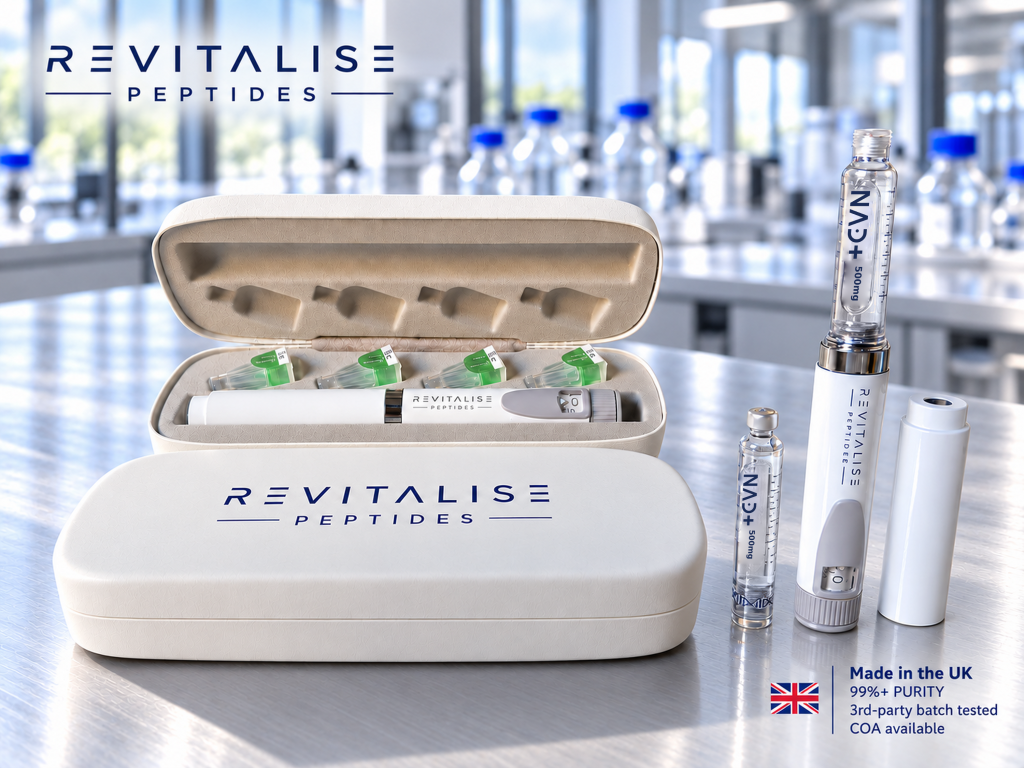
A bundle contains individual products supplied together. A blend contains more than one compound within a single preparation. A research plan may call a group of separately sourced materials a stack even when no product is physically combined. Cartridge stacks can also refer to a set of compatible refill cartridges rather than a molecular mixture. The product description, label and batch documentation establish which meaning applies.
A stack is not automatically a combination experiment
The central scientific distinction is simple: purchasing compounds together does not demonstrate an interaction between them.
A genuine combination experiment needs a design capable of separating the effects of each material from the effect of their joint use. At minimum, that normally means appropriate individual-compound conditions, a combination condition, relevant controls and a pre-specified analytical approach. Without these, an observed result cannot reliably be attributed to the relationship between the materials.
Researchers sometimes use terms such as additive, synergistic or antagonistic too loosely. Additivity means the joint effect is consistent with an established reference model. Synergy describes an effect greater than that model predicts, while antagonism describes a lower effect. The conclusion depends on the model selected, the endpoint, the concentration range and experimental uncertainty.
This is not just semantic caution. Bliss independence and Loewe additivity make different assumptions about how agents act, and may produce different interpretations from the same data. Bliss set out the independent-action framework in 1939, while Chou and Talalay described a quantitative approach for analysing dose-effect relationships and combinations in 1984. These methods are useful tools, not universal proof that two research materials have a biologically meaningful partnership.
Why researchers build peptide stacks
A well-considered stack begins with a question rather than a catalogue category. For example, a laboratory may wish to examine signalling pathways that are mechanistically distinct but relevant to the same cellular model. Another project may compare separate materials across recovery-related, metabolic, neurobiological or cellular-stress endpoints.
There can be sound practical reasons to procure several related materials together. It can simplify stock planning, reduce repeated ordering and help standardise records across a defined project. Bundles may also make it easier to keep associated consumables and compatible formats organised.
That convenience has a trade-off. A grouped purchase can encourage researchers to assume that the materials have an established relationship. In many cases, the evidence base for each compound is uneven: one may have substantial cell or animal literature, while another has limited published characterisation in the relevant model. Human evidence, where it exists, must be considered separately and does not convert research materials into medicines or establish a clinical use.
The evidence questions to ask before selecting a stack
Before treating a collection as a coherent research set, assess the proposed relationship at three levels: biological plausibility, direct evidence and material quality.
Biological plausibility asks whether the compounds are associated with pathways that could reasonably be studied within the same model. Shared terminology is not enough. A claim that two materials both relate to tissue signalling, for instance, says little about whether their effects overlap, complement one another or interfere under specific experimental conditions.
Direct evidence is stronger than plausibility. Look for studies that tested the actual combination, in a comparable model, against appropriate single-material controls. Cell findings can inform mechanistic questions, but they do not establish outcomes in animals or humans. Likewise, animal findings can guide translational hypotheses but should not be presented as confirmed human effects.
Material quality concerns whether the identity and stated content of each item can be assessed. This is especially relevant for a pre-combined blend, where a researcher may need to understand the identity and amount of every stated component rather than treating the product as a single opaque item.
Documentation matters more with multi-compound research
The more materials a project contains, the more opportunities there are for avoidable ambiguity. A useful research record links each material to its product name, stated amount, batch or lot identifier, supporting documentation, receipt date, storage record and use within the study plan.
A certificate of analysis can be informative, but it should be read for the question it actually answers. Identity, purity and content are related but distinct. High-performance liquid chromatography is commonly used to indicate chromatographic purity, whereas mass spectrometry is used to support molecular identity. Neither result alone establishes every aspect of a material’s suitability for a particular experiment.
For a stack, check whether documentation is specific to each constituent and batch. Do not assume that documentation for one vial applies to another simply because they were bought together. Where a supplier provides verification resources or batch documentation, retain the relevant records with the project file and compare the stated product format with what was ordered.
Blends require extra clarity
Pre-formulated blends can be appropriate where a research question genuinely requires a fixed composition. They also reduce flexibility. If an unexpected result appears, it may be harder to attribute that result to one constituent, adjust the ratio or identify a stability issue affecting a single component.
Separately supplied materials offer more experimental control, but they require more careful planning and record-keeping. Neither format is inherently superior. The appropriate choice depends on whether standardisation or component-level investigation is the priority.
A practical way to define a peptide stack
For procurement and study planning, write a short stack definition before ordering. It should state the compounds under consideration, the research question, whether they will be evaluated individually or jointly, the required controls and the documentation required for each material.
This small step prevents a commercial label from becoming an unexamined scientific claim. It also makes it easier to exclude a compound if its format, documentation or available evidence does not fit the project.
If a project involves a combined condition, predefine how the result will be interpreted. Specify the endpoint, comparison groups, timing, replication and statistical method. For formal interaction analysis, ensure the experimental design supports the chosen reference model rather than selecting a synergy label after results are known.
Research-only boundaries remain clear
Peptide stacks sold for laboratory research are not treatment plans, personal-use regimens or evidence of safety or effectiveness in people. Product grouping does not imply regulatory approval, therapeutic intent or suitability for human or veterinary use.
Researchers should also avoid importing conclusions from one context into another. A finding in an in-vitro assay may be valuable, yet still be limited by the cell type, assay conditions, endpoint and concentration range. Clear reporting of those constraints is part of good combination research.
The most useful next step is to define whether the stack you are considering is a bundle, a blend or an experimental design, then review the product-specific documentation for every constituent before it enters a research workflow.