How to Use Refillable Peptide Pens for Research
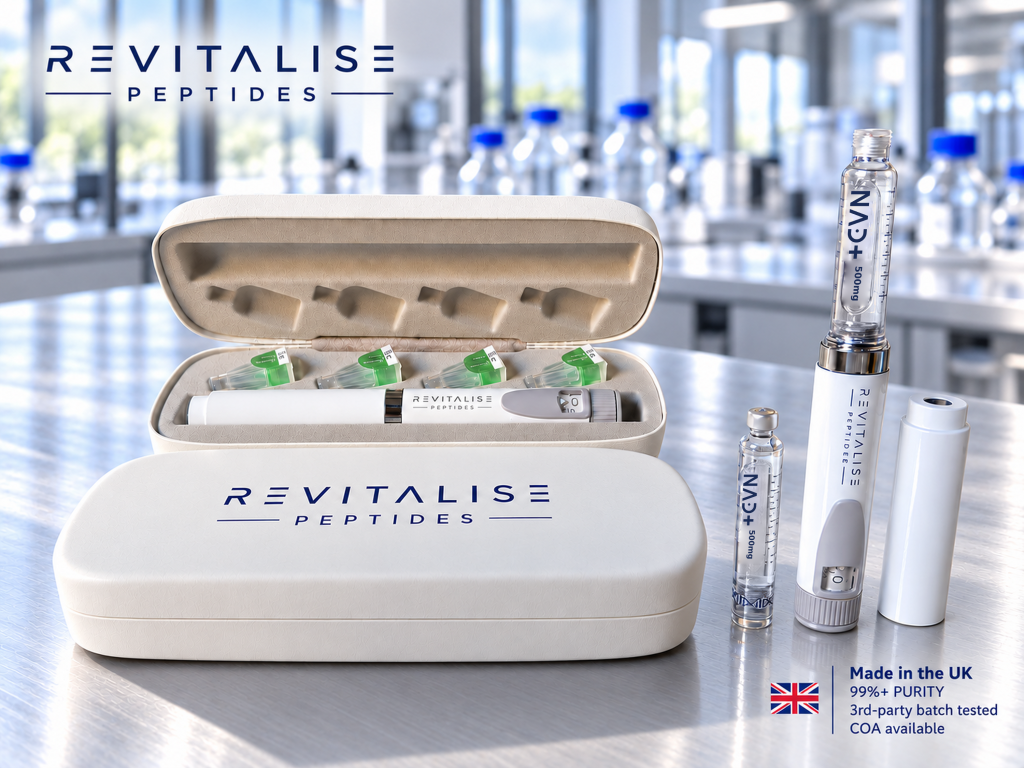
A reusable pen system can make a repeat research workflow easier to organise, but it does not change the identity, quality or intended status of the material inside it. To use refillable peptide pens appropriately, treat the pen, cartridge and supporting records as one controlled format rather than as separate accessories. For laboratory and non-clinical research only, the priority is traceability: confirming what material is present, which cartridge it occupies, and which documentation applies to that specific item or batch.
Refillable formats are particularly useful where a researcher is working through repeat observations, comparing labelled research materials, or trying to reduce the handling associated with multiple separate containers. They are not medicines and are not intended to diagnose, treat, cure or prevent disease. A pen format is also not evidence of suitability for human or veterinary use.
What a refillable peptide pen changes
The principal advantage of a refillable peptide pen is format consistency. A compatible reusable body and cartridge system can provide a more orderly way to hold, identify and revisit research material than repeatedly opening multiple containers. This can support cleaner stock organisation, particularly where several compounds, batches or experimental conditions must be kept distinct.
It is important, however, not to mistake convenience for a scientific control. A cartridge does not establish identity, concentration, purity or stability. Those questions are answered by the product label, the relevant certificate of analysis, analytical documentation and the researcher’s own records. The pen should therefore sit within an existing documentation process, not replace it.
Peptide and protein-like materials may be sensitive to several forms of stress, including temperature variation, light exposure, agitation and contact with unsuitable surfaces. The scale of that sensitivity depends on the compound, formulation and container system. Manning and colleagues reviewed how aggregation and chemical degradation can affect protein pharmaceuticals, illustrating why format and handling conditions require compound-specific consideration rather than general assumptions (Manning MC et al., Pharmaceutical Research, 2010, 27, 544-575). That literature provides useful context, but it does not validate a particular cartridge or establish stability for any individual research product.
Before you use refillable peptide pens
Start with compatibility rather than convenience. A refillable pen body is designed around a particular cartridge type and connection system. Do not assume cartridges that appear similar are interchangeable. Confirm the product description, the intended refill format and any manufacturer-provided instructions for the specific reusable system before assembling anything.
Next, create a clear material record. At minimum, record the compound name, product strength or stated content, batch or lot reference where supplied, cartridge identifier, date prepared or placed into the system, and the related documentation reference. If the workflow involves several materials with similar names, assign a distinct internal sample code as well. A label that is legible today but ambiguous after several weeks is not adequate traceability.
Finally, review the product-specific storage and handling information before transferring or using a format. There is no universal storage temperature or shelf-life statement that applies across peptide research materials. Follow the documentation supplied for the relevant product and avoid extrapolating from another peptide, vial or cartridge. If instructions are unavailable or conflict with the configuration in hand, pause the workflow and seek clarification rather than improvising.
Keep cartridge records separate from COA interpretation
A certificate of analysis is valuable, but it answers defined analytical questions rather than every practical question in a workflow. For example, HPLC is commonly used to assess chromatographic purity under stated test conditions, whereas mass spectrometry helps confirm molecular mass and identity. Neither result alone proves the quantity of material in a cartridge at a later date, nor does it demonstrate long-term stability after handling.
Similarly, purity and content are related but different concepts. A high reported purity does not, by itself, confirm fill quantity, and a stated amount does not explain the profile of impurities. Read the method, result, batch reference and scope of the document together. If a cartridge stack or refill is part of the workflow, make sure the documentation can be matched unambiguously to the relevant research material rather than merely to the reusable hardware.
A controlled workflow for refillable formats
The best approach is deliberately unglamorous: define the workflow before opening the product. Decide which project, sample group or observation period the cartridge represents. Prepare labels and records first, then minimise unnecessary handling. This reduces the chance that a correct material becomes an untraceable one.
A practical sequence is to inspect the reusable pen and cartridge for visible damage, confirm they are the intended compatible components, and verify the label against the record before use. Record each meaningful format change or transfer in the same notebook, spreadsheet or laboratory information system used for the rest of the project. Where a cartridge is removed from use, document the reason, such as completion of a study stage, a suspected handling deviation or a need for review.
Avoid relying on visual appearance as confirmation of identity or quality. Changes in clarity, colour or particulate matter may justify a pause and investigation, but an unchanged appearance is not proof that a material remains within specification. Likewise, device markings may assist with repeatable handling within a defined system, but they are not an analytical measurement and should not be treated as one.
Refillable pens, vials and cartridge stacks compared
The most suitable format depends on the research workflow, the volume of material required and how often the same item needs to be revisited. Neither format is automatically superior.
| Format | May suit | Main control point | | — | — | — | | Research vial | Initial receipt, defined single-stage work or bespoke preparation workflows | Maintain a clear record of preparation, container changes and product-specific handling conditions. | | Refillable pen set | Repeat work where compatible cartridges and consistent physical organisation are useful | Confirm pen-cartridge compatibility and maintain cartridge-level identification. | | Refill cartridge | Continuing work within an established compatible reusable system | Prevent mix-ups between similar cartridges, compounds and batches. | | Cartridge stack or bundle | Planned procurement across several related research stages | Check every component against its own label and documentation rather than treating the bundle as one analytical unit. |
Vials can offer flexibility where the researcher needs a format that aligns with an existing laboratory process. Refillable systems can reduce clutter and make repeated physical handling more consistent. Cartridge stacks can help with procurement planning. The trade-off is that each additional format transition creates another point at which labelling, compatibility or recordkeeping can fail.
Common errors that weaken a research record
The most frequent issue is assuming that a reusable format carries the same information as the original product container. Once material is separated from its original packaging, the risk of losing its batch connection increases. Retain the original label and accompanying paperwork for the duration of the project, and ensure the cartridge record points back to them.
Another error is combining materials, components or records because they seem equivalent. Two items may share a compound name but differ in batch, stated content, analytical documentation or date received. Keep them distinguishable unless the project protocol specifically addresses how they are to be compared or pooled.
A third issue is using generic online guidance as a substitute for product documentation. Broad handling advice may be useful for understanding risk, but it cannot confirm the requirements for a particular research peptide. Product-specific instructions and batch documentation take precedence. Where quality claims matter to the study, review the available analytical information carefully and distinguish tested attributes from assumptions.
When a refillable format is the sensible choice
Choose a refillable peptide pen when the reusable system genuinely improves organisation without obscuring the chain of identity. It may be a sensible option for researchers who can maintain a consistent cartridge labelling convention, have confirmed component compatibility and need a repeatable physical format for an ongoing non-clinical workflow.
It may be less suitable where the work requires frequent changes between unrelated materials, where the available records cannot be reliably tied to each cartridge, or where the relevant product documentation does not support the intended handling arrangement. In those cases, a clearly labelled research vial may offer the more defensible starting point.
For Revitalise Peptides customers, the useful next step is to review the current documentation and compatibility information for the exact reusable pen set or refill under consideration, then select the format that preserves the clearest research record from receipt through to project close.