Are Research Peptides Medicines? A Clear Answer
A vial may contain a compound that is being investigated in medicinal science, but that does not make the vial itself a medicine. Are research peptides medicines? Generally, no: a peptide supplied solely as laboratory research material, without therapeutic claims or authorisation for patient use, is not an authorised medicine. The distinction matters for procurement, documentation, handling and, above all, the limits of what a supplier can represent.
For buyers assessing research materials, the useful question is not simply whether a molecule has biological activity. Many substances do. The question is how the finished product is classified, presented, manufactured, documented and intended to be used.
Are research peptides medicines under UK rules?
A research peptide is a short chain of amino acids supplied for scientific investigation. It may be studied in cell systems, analytical work, receptor assays, animal models or other non-clinical settings. Some peptides under investigation may also be active ingredients in authorised medicines in a different formulation, strength or presentation. That overlap at molecular level does not transfer medicinal status to every research product containing the same sequence.
In the UK, medicines regulation considers factors including a product’s presentation and function. Products presented as preventing or treating disease, or intended to exert a pharmacological, immunological or metabolic action for a medical purpose, can fall within medicines legislation. Classification is fact-specific, and research-only wording is not a substitute for complying with applicable restrictions.
An authorised medicine has been assessed through the relevant regulatory route for defined uses and is supplied with approved product information. A laboratory research material is not supplied on that basis. It must not be represented as suitable for diagnosing, treating, curing or preventing disease, and research discussion must not be mistaken for a therapeutic claim.
This is why a product page that describes receptor binding, signalling pathways or preclinical findings should be read as scientific context, not as an instruction or a statement of clinical benefit.
The practical difference between a research material and a medicine
The difference is clearest when procurement requirements are compared directly.
| Question | Research peptide material | Authorised medicine | |—|—|—| | Primary purpose | Non-clinical laboratory or educational research | A defined medical use in people, as authorised | | Product claims | Scientific and analytical context only | Approved therapeutic indications and safety information | | Evidence standard | Depends on the research question and supplier documentation | Regulatory assessment of quality, safety and efficacy for the authorised use | | Manufacturing and release | Documentation should be assessed for the specific material and batch | Controlled under the standards and release requirements applicable to medicines | | Labelling | Research-use limitations and material identification | Patient- and prescriber-facing medicinal information | | Human use | Not intended for human or veterinary use | Used only in accordance with its authorisation and professional guidance |
The table does not mean research materials are unimportant or poorly characterised. It means the evidence package answers different questions. A researcher may need identity confirmation and suitable analytical data to support an assay. A regulator evaluating a medicine must consider a far wider body of evidence, including manufacturing consistency, toxicology, clinical safety, efficacy and ongoing pharmacovigilance.
Biological activity is not clinical evidence
Peptides are often studied because they can interact selectively with receptors, enzymes, transport systems or signalling pathways. A finding in a receptor assay can be useful. So can a change in a cell marker, an effect in an animal model or a pharmacokinetic observation in a controlled human study. These are not interchangeable forms of evidence.
Cell research can help identify a mechanism, but it cannot establish effects in a whole organism. Animal work can test more complex biological questions, yet differences in metabolism, receptor expression, disease modelling and exposure can limit translation to people. Human studies may address some of those gaps, but early studies, small samples or narrow populations still cannot establish a general medical use.
The progression is deliberate rather than bureaucratic. A plausible mechanism is a starting point, not a therapeutic conclusion. This is particularly relevant for peptides associated with metabolic signalling, tissue pathways, neurobiology, cellular stress responses or extracellular-matrix research, where public discussion can run ahead of the evidence.
Why “research use only” needs to be taken seriously
A research-use statement is a boundary on intended use. It tells the purchaser that the material is supplied for laboratory research rather than personal, clinical or veterinary use. It should change how the product is evaluated and how its documentation is interpreted.
It does not mean that every use becomes permitted simply because a label says “research”. Nor does it establish that a product is suitable for any particular method, model or experimental system. Researchers remain responsible for determining whether a material is appropriate for their work, meeting institutional requirements and following applicable law, ethics procedures and laboratory controls.
For independent and small-scale research operations, this distinction also protects the integrity of the work. A project framed around a clear non-clinical question can set defined acceptance criteria, record batch information and state its limitations honestly. A project framed around presumed personal outcomes cannot do the same scientific job.
What documentation can tell you
Documentation is valuable, but it has defined limits. A certificate of analysis, or COA, should be read as batch-specific supporting information rather than a universal quality guarantee. Start by checking that the material name, batch or lot identifier, test date and supplier details correspond with the item being assessed.
Then separate three questions that are often incorrectly combined. Identity asks whether the expected peptide is present. Purity asks how much of the analysed material is attributed to the target peak or component under the stated method. Content asks how much material is present in the container. One result does not automatically answer the other two.
High-performance liquid chromatography, commonly called HPLC, is frequently used to separate components and assess chromatographic purity. It can reveal peaks consistent with impurities, but its result depends on the method, detector and integration approach. Mass spectrometry addresses a different question: whether the observed molecular mass is consistent with the expected peptide. It is useful for identity support, but it does not independently establish chromatographic purity or vial content.
A meaningful review therefore asks what method was used, whether the result belongs to the relevant batch, and what the test can actually demonstrate. It should also consider whether the documentation is sufficient for the planned research. For some work, a basic identity and purity screen may be relevant. For more sensitive analytical, cell-based or comparative work, further controls and verification may be needed.
Do not infer sterility, endotoxin status, stability, clinical-grade manufacture or suitability for a particular biological system from an HPLC trace or mass result alone. Those are separate attributes that require separate evidence.
Choosing materials without treating them as medicines
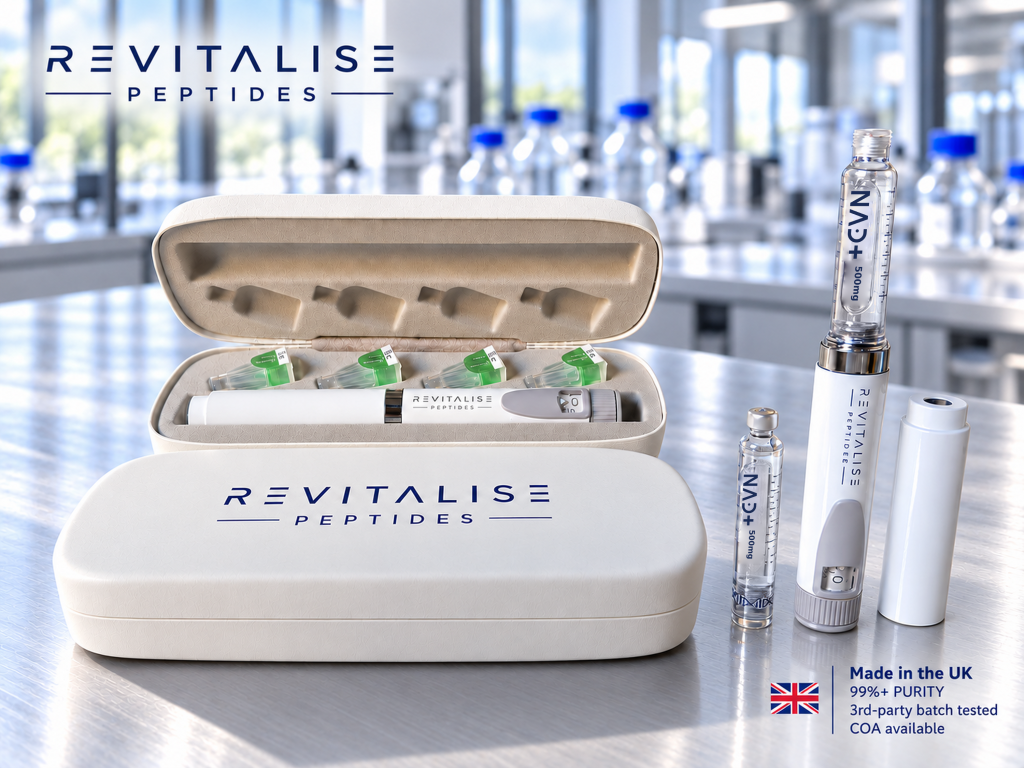
A disciplined purchasing process begins with the experimental question. Define the peptide or pathway of interest, the required format, the amount needed for the planned work and the documentation necessary to support traceability. Research vials, cartridges, bundles and other formats may make organisation easier, but format is not a clinical qualification and does not change the intended research-only status of the material.
Next, review the product-specific documentation available at the point of purchase. Check the nomenclature carefully, particularly where similar peptide names, salt forms or blends can be confused. Retain the batch information alongside laboratory records, and use product-specific manufacturer guidance rather than assuming a universal storage condition or shelf life.
Finally, keep product claims proportionate to the evidence. A supplier can describe the compound, its analytical documentation and the scientific pathways being investigated. It should not convert a literature discussion into a promise of safety, effectiveness or a medical outcome. Revitalise Peptides supplies laboratory research materials on this basis, with product documentation and verification information intended to support informed research procurement.
If you are deciding whether a material is appropriate for a project, review the relevant batch documentation first, define the evidence your method requires, and treat any unanswered quality question as a reason to seek clarification rather than make an assumption.