A peptide can produce a clean-looking HPLC chromatogram and still require further identity work. Equally, a mass result can match the expected molecular weight without demonstrating that the sample is free from closely related impurities. That is why the question of HPLC vs mass spectrometry for peptide testing is not usually about choosing a single winner. It is about understanding what each method can support on a batch record.
For researchers procuring peptide materials, the practical distinction matters. HPLC is commonly used to assess chromatographic purity, while mass spectrometry is primarily used to support molecular identity. Neither result, read alone, establishes every aspect of a material's quality, concentration, handling history or suitability for a particular research workflow.
The short answer: use the methods for different questions
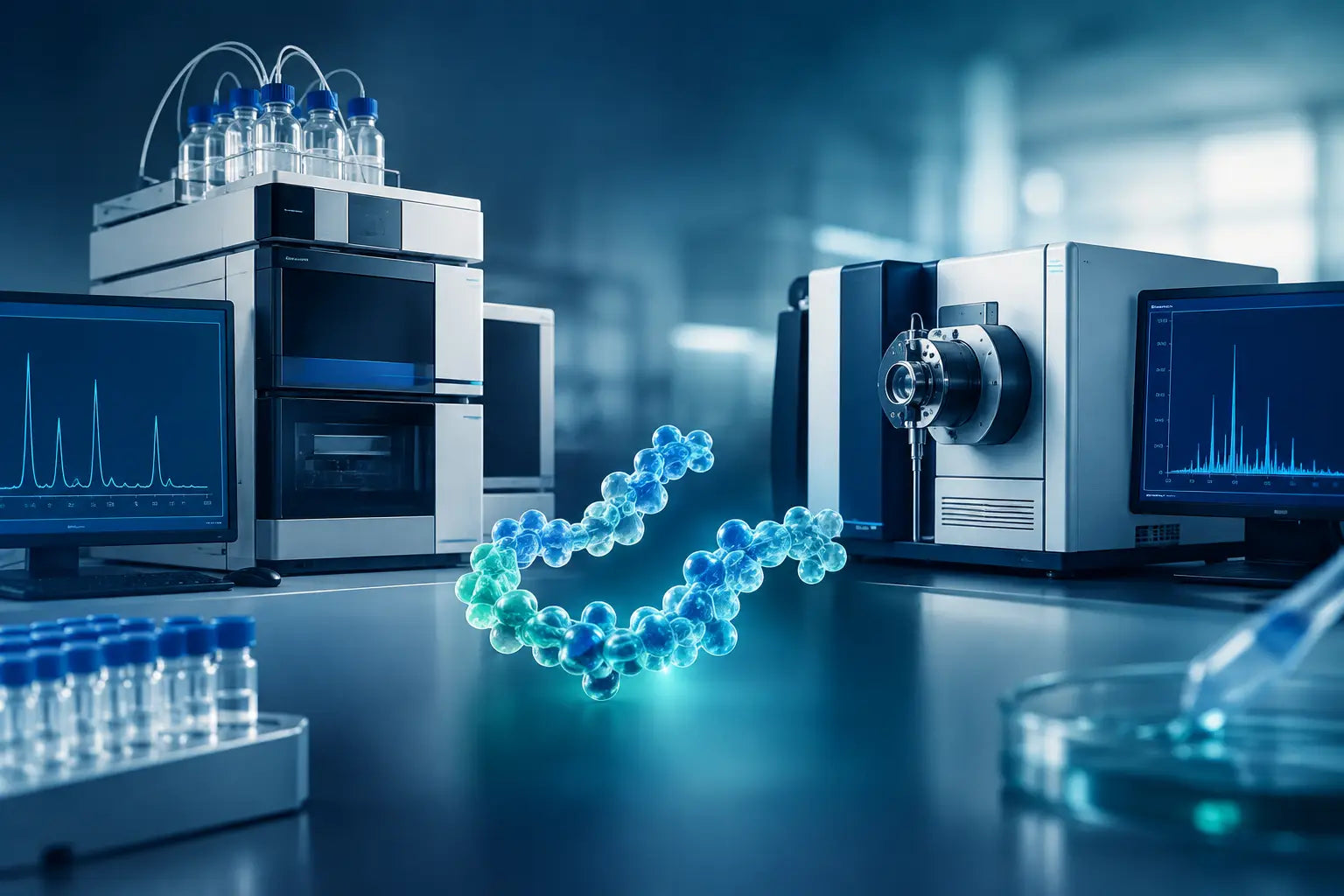
High-performance liquid chromatography, or HPLC, separates components in a sample. The resulting chromatogram shows peaks at different retention times, allowing the laboratory to estimate whether one component dominates the mixture and whether detectable secondary peaks are present.
Mass spectrometry, often abbreviated to MS, measures ions according to their mass-to-charge ratio. For an intact peptide, it can indicate whether the observed molecular mass is consistent with the expected compound. When coupled with chromatographic separation, LC-MS can connect a chromatographic peak to a corresponding mass signal.
In simple terms, HPLC addresses the question, how complex is this sample under this test method? MS addresses, is the measured mass consistent with the intended molecule? A well-considered peptide testing package often uses both.
HPLC vs mass spectrometry for peptide testing: key differences
| Question | HPLC | Mass spectrometry |
|---|---|---|
| Main purpose | Separates components and estimates relative peak composition | Supports molecular identity through measured mass |
| Typical output | Chromatogram, retention times and peak areas | Mass spectrum, observed mass or mass-to-charge values |
| Best suited to | Detecting chromatographically resolved impurities | Confirming expected intact mass and investigating peak identity |
| Main limitation | A peak area does not prove chemical identity | Matching mass alone does not prove chromatographic purity or quantity |
| Quantitative use | Can support assay or purity work when appropriately validated | Can support quantitation, but requires suitable calibration and method control |
The instruments themselves are not interchangeable. A UV-HPLC method detects compounds because they absorb light at a chosen wavelength. Peptides commonly absorb in the low UV range through peptide bonds, while aromatic residues may contribute stronger signal at higher wavelengths. The detector response, however, varies between compounds. A percentage calculated from peak area is therefore a chromatographic result under specific conditions, not a universal statement that every impurity has been measured equally.
Mass spectrometry offers a different type of selectivity. Modern peptide analysis commonly uses electrospray ionisation, which produces several charged forms of the same peptide. Software or an analyst can deconvolute these charge states to estimate the neutral molecular mass. A close match between expected and observed mass is useful identity evidence, particularly when interpreted alongside retention time and method details.
What an HPLC purity result can tell you
A typical HPLC certificate of analysis may report a principal peak and a percentage purity value. In peptide procurement, this is often the first figure readers look for. It is useful, but it needs careful interpretation.
The reported value normally reflects the area of the main detected chromatographic peak as a proportion of the total integrated peak area. It can show whether the method detected notable related species, synthesis by-products or degradation products that separate from the principal peak. Retention time can also help identify whether the main signal appears consistently within that method.
Yet chromatographic purity is not synonymous with peptide content. A sample could include residual water, counterions, salts or other non-UV-active material that does not contribute proportionately to the chromatogram. It is also possible for two components to co-elute, meaning they appear as one peak under the stated conditions. This is why an HPLC figure should always be read as method-dependent rather than as an absolute description of everything inside a vial.
Why the method conditions matter
Useful HPLC documentation identifies more than a headline percentage. Look for the column chemistry, mobile phases, gradient, detection wavelength and integration approach where these are provided. Those details determine how effectively the method can separate the peptide from potential related compounds.
A reversed-phase HPLC method, for example, separates largely according to hydrophobic interactions. It is widely applicable to peptides, but it may not resolve every possible impurity. Method development and validation determine whether a particular separation is fit for its intended purpose.
What mass spectrometry adds to peptide identity testing
The sequence of a peptide determines its theoretical molecular weight. MS can compare that theoretical value with the measured intact mass. This is especially useful for detecting a clear mismatch caused by an incorrect sequence, an unexpected truncation or a substantial modification.
However, mass matching has boundaries. Isomeric compounds can share the same molecular mass. Sequence order matters in peptides, and different sequences may occasionally be isobaric, meaning that they have indistinguishable nominal or exact mass. Some modifications may also be difficult to distinguish without further experiments.
For greater structural confidence, laboratories may use tandem mass spectrometry, or MS/MS. In this approach, peptide ions are fragmented and the resulting pattern can provide sequence-related information. It is a more informative identity tool than intact mass alone, but its value still depends on spectral quality, interpretation rules and the question being investigated.
MS is also highly sensitive. That sensitivity is valuable for investigating low-level components, but it means sample preparation, carryover control and data processing deserve attention. A mass spectrum is not simply a pass-or-fail image. It is an analytical record that should be interpreted within a defined method.
Why HPLC and MS are strongest together
The most informative workflow often combines chromatographic separation with mass-based detection. In LC-MS, the HPLC stage separates the mixture before compounds enter the mass spectrometer. This lets the laboratory ask two connected questions: does the sample contain more than one chromatographic component, and what mass is associated with each component?
Consider a secondary HPLC peak. UV-HPLC may show that it is present but not reveal what it is. LC-MS may help determine whether that peak has a mass consistent with a deletion sequence, oxidation product, adduct or another related species. These remain analytical interpretations, not assumptions, and may need confirmation through reference materials or additional orthogonal testing.
Conversely, an expected mass in an MS result becomes more meaningful when it aligns with the principal chromatographic peak. The combined evidence is more useful than either result viewed in isolation.
Purity, identity and content are separate questions
These terms are often grouped together in product discussions, but they describe different analytical objectives.
Identity asks whether the tested material is consistent with the intended peptide. Intact-mass MS, and where required MS/MS, can contribute to this assessment.
Chromatographic purity asks how much of the detected chromatographic signal is represented by the main peak under a stated HPLC method.
Content asks how much peptide is actually present by mass or amount. Establishing content requires an appropriate quantitative method, suitable standards and controlled sample preparation. A stated vial mass, an HPLC area percentage and a matching mass spectrum do not automatically constitute a content assay.
This distinction is particularly relevant where researchers need to compare batches, prepare analytical standards or interpret a reported milligram quantity. Documentation should describe the test result actually obtained, rather than imply that one metric answers every quality question.
How to read a peptide COA more critically
A certificate of analysis is most useful when it is traceable to the product or batch under review. Start by checking the material name, batch or lot identifier, test date and the laboratory or testing party named on the document. Then consider whether the HPLC and MS data refer to that same identifiable batch.
For HPLC, look beyond the percentage figure. Is a chromatogram included? Does it show a clearly identified main peak, a retention time and any notable secondary peaks? Are the test conditions described sufficiently to understand what was measured?
For MS, check whether the expected and observed molecular masses are stated, and whether the reported values are plausibly close in the context of the method. If a spectrum is included, it should be associated with the sample rather than presented as a generic example. A result labelled as LC-MS may be particularly useful because it relates separation and mass detection, though the detail provided still matters.
A COA is not a substitute for risk assessment, method suitability work or independent verification where a research project requires it. It is procurement documentation: evidence that should be proportionate to the material, intended analytical use and consequences of an incorrect result.
Choosing the right evidence for your research workflow
If the immediate question is whether a supplied peptide is consistent with its declared molecular mass, MS evidence is central. If the question is whether detectable related components are separated from the main component, an HPLC chromatogram is central. If your work depends on accurate peptide amount, ask whether a dedicated content or assay method has been used rather than treating purity as a proxy.
For research-use materials, documentation should support informed laboratory decisions without being overstated as evidence of clinical quality, therapeutic effect or personal-use suitability. The appropriate test package depends on the compound, the formulation, the stage of research and the level of certainty required.
Before selecting a peptide format, review the current batch-specific documentation available for the material you are considering and check that the stated methods answer the question your research actually asks.